MCP for Hotel Marketing and Direct Bookings
AI assistants can take part in a hotel's discovery journey and, when equipped with the right tools, guide the traveler toward a booking. For the marketing team, the challenge is to prepare reliable information, make the direct booking path accessible and measure what happens along that journey.
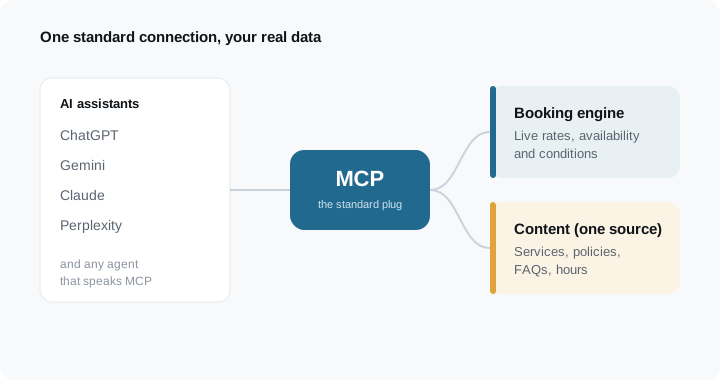
The Model Context Protocol (MCP) is an open standard that lets AI assistants connect to external data and tools. To learn the fundamentals, see what an MCP is for hotels. Here we focus on its practical application to marketing and bookings.
What changes for hotel marketing?
Preparing an MCP connection means treating hotel information as part of the commercial experience, not just as website content. The marketing team must coordinate with reservations and technology to decide what data is shared, who maintains it, and where the traveler is sent when they want to book.
- Useful content for specific queries. Rooms, amenities, location and policies must be described clearly to answer needs such as traveling with children or looking for an accessible room. The importance of context is explained in prompt complexity.
- A path to the direct booking. When possible, the assistant can present a link to the hotel's booking engine or use an authorized booking tool. The journey depends on the integration and the assistant's capabilities, as discussed in the agentic web and ARD.
- Consistency across teams and channels. Marketing, reservations and technology must agree on information sources and check that the terms communicated match those on the booking engine.
MCP does not guarantee that a hotel will appear in a response or that the traveler will book. The recommendation also depends on the query, the assistant and the sources it uses.
How can assistants use MCP to query and book?
Assistants such as ChatGPT, Gemini, Claude or Perplexity can use external sources and tools in certain configurations. To use a specific MCP connection, the product, configuration and permissions must support it; it is not enough for the hotel to publish its data.
In one possible journey, the traveler states destination, dates and preferences. The assistant queries, through a compatible connection, the information the hotel has made available: for example, room types, amenities or conditions. If a tool connected to the booking system exists, it can also request rates and availability for the stated dates.
To complete the booking, the assistant could provide a link to the direct engine or invoke a booking tool, provided it is available and authorized. The hotel must check how the booking is confirmed and how personal data and payment are handled. How often rates and availability are updated depends on the systems and the integration; this should be confirmed before communicating it to the traveler.
How can a hotel prepare? Step by step
- Define the goal. Decide whether the priority is improving the information assistants receive, generating visits to the direct engine, or enabling bookings through a connected tool.
- Organize the data. Gather room descriptions, amenities, location, policies and conditions. Identify the sources for rates and availability and assign owners for their review.
- Review the booking journey. Check that the direct engine lands the user on an appropriate page, shows the applicable conditions and allows the booking to be completed. If a tool that places bookings is being considered, define which actions require authorization.
- Plan the integration. With the technical team and involved providers, determine which data and tools will be exposed through MCP, how the systems will connect, and how often the information will be updated.
- Test queries and bookings. Try searches with different dates and preferences, review the responses, and check the links, conditions and the confirmation of the booking process when enabled.
- Publish, measure and correct. Keep a periodic review of content and results. If services or policies change, update the relevant source and re-test the relevant queries.
How does Listo AI fit into the preparation?
Listo AI approaches hotel data integration through APIs and management dashboards. Before starting, it's worth reviewing with the team which inventory and booking systems can be connected, what information is managed from the dashboard, and which query or booking functions are available for each case.

Implementation should be accompanied by testing with the assistants and channels the hotel wants to use. This helps confirm actual compatibility and catch incomplete data or booking journeys that need adjustment.
What to measure in marketing and direct bookings
Set a baseline before activating the integration and review results periodically. Useful metrics include:
- Information quality: the percentage of test queries with correct, complete data, and errors detected by type.
- Test visibility: the hotel's presence across a stable set of relevant queries, bearing in mind results can vary between sessions and assistants.
- Traffic to the direct channel: visits to the booking engine from identifiable assistant links, when attribution is available.
- Conversion: the share of those visits that starts and completes a direct booking.
- Business outcome: bookings and revenue attributable to the journey, along with cancellations, if they can be measured reliably.
Not every visit or booking can be attributed to an assistant. Document the limitations of measurement and use tracking parameters and analytics while respecting applicable privacy rules and consent. To go further on discovery, see hotel recommendations in AI.
Current limitations and challenges of MCP
A connection can only offer the information and tools that have been prepared and authorized. If the data is incomplete or outdated, the responses can be too. Compatibility also varies by assistant, its configuration and the hotel's systems.
The team must review access permissions, data protection and tool behavior before allowing actions such as creating a booking. It's also worth defining a procedure for correcting errors and removing or updating information when necessary.
Practical takeaway
For marketing, MCP is an opportunity to better prepare hotel information and connect discovery with direct booking. The first step is not to promise more visibility, but to organize the data, test the journey and measure the results that can be reliably attributed.

FAQ
Which hotels can prepare to use MCP?
Both independent hotels and chains can consider an integration. They need to identify their information sources and check the compatibility of their systems and providers.
Does MCP guarantee my hotel will appear in every assistant?
No. Appearance depends on the query, the assistant's capabilities and configuration, and the sources it uses. You can learn more in how your hotel shows up in ChatGPT.
Can an assistant complete a direct booking?
It may be possible if a connected and authorized booking tool is available. In other cases, the journey can continue through a link to the hotel's booking engine.
Does the marketing team need advanced technical knowledge?
Not necessarily to prepare content and goals, but the connection and testing may require technical support and collaboration with providers. The context of the journey is covered in the agentic web and ARD.
Ready to prepare your hotel for AI assistants?
Request a personalized demo of Listo AI.
Request a demo →