Hotel Recommendations On AI Search: What The Numbers Say
Travellers have started asking AI assistants where to stay. "Find me a boutique hotel in central Barcelona," they type, and a confident answer comes back naming three or four properties. If your hotel is one of them, you have just won a booking you never had to pay an OTA commission on. If it is not, you will probably never know you were in the running at all.
That is the uncomfortable part. With Google you can see your ranking. With an AI assistant the decision happens inside a black box, and most of the advice circulating online about how to influence it is guesswork or hearsay. Luckily, we ran the numbers. We asked three of the most widely used assistants, ChatGPT, Claude and Gemini, the same one hundred travel-related questions, extracted from publicly available banks of real AI search queries, and repeated it enough times to draw firm conclusions. This represented roughly 1,500 individual conversations covering everything from "best hotels in the area" to "family friendly" and "luxury five star." We then traced every source each AI assistant used to both build up its answer and recommend a hotel, analysing down who owned that domain, what technical characteristics it had, and how the data was structured. Overall, we analysed over 9,000 sources. Sometimes you just have to do it yourself. Here is what the data shows.
AI search is not one surface
The first finding is also the one most likely to trip up a hotelier or an agency: there is no single thing called "AI search" to optimise for. The major platform assistants behave like genuinely different machines, and they pull their recommendations from different places.
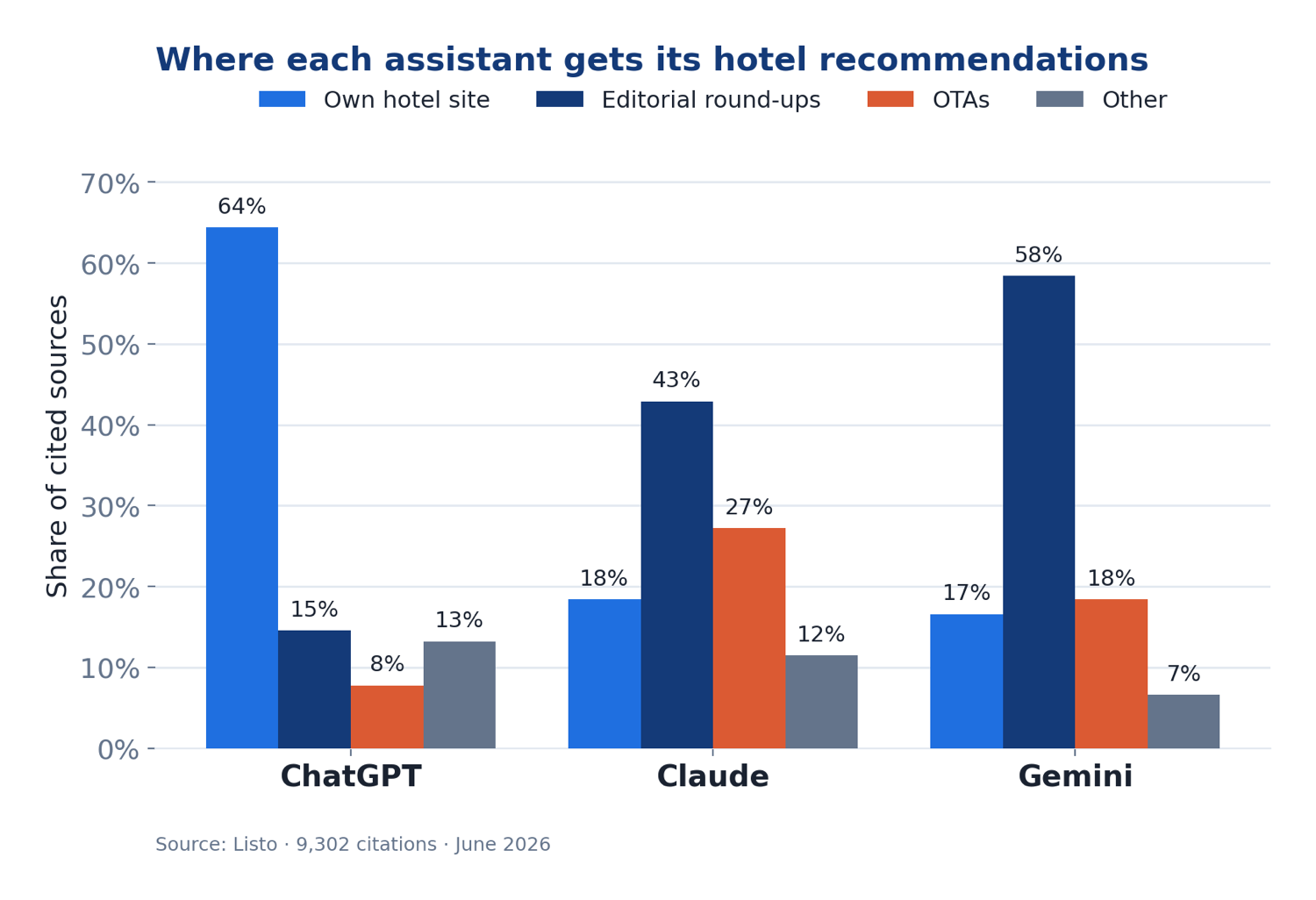
ChatGPT, more than anything else, reads the hotel's own website. Roughly 64% of the sources it cited when coming up with a recommendation were official hotel sites. Claude leans on a mix of editorial round-ups (about 43%) and OTA pages like Booking and Expedia (about 27%). Gemini is the most editorial-led of the three, with close to 58% of its citations coming from third-party articles. Put plainly, ChatGPT cites a hotel's own website around four times more often, as a share of its sources, than Gemini does.
In practice this means that there is no one universal trick, despite desperate attempts by LinkedIn gurus to make it seem that way. Pour everything into your own website and you will do well on ChatGPT and very little on Gemini. Win on editorial coverage and you tilt Claude and Gemini your way while barely moving ChatGPT. Visibility has to be earned across several surfaces at once, not optimised in a single place. This means that a holistic AI visibility strategy is not a one-time endeavor, but rather a sustained effort to increase the quantity and quality of digital information across various channels.
Being readable is the entry ticket
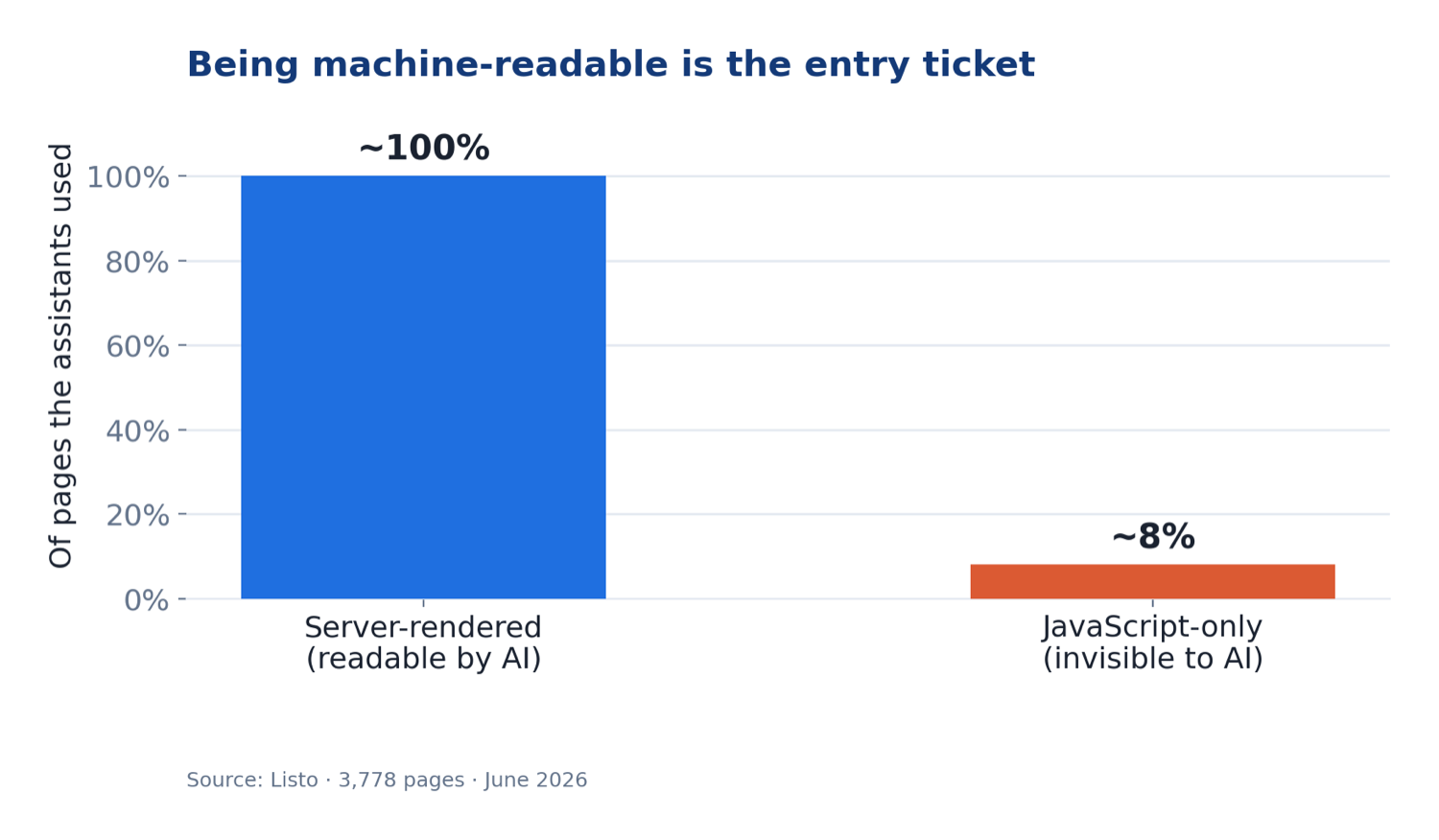
The second finding regards the technical reality underneath all of this that is non-negotiable. Almost every page the assistants successfully used was server-rendered, meaning the content was present in the initial HTML response itself rather than loaded afterwards by JavaScript. Around 8% of the pages the assistants tried to use were JavaScript-only, and those were effectively invisible. The crawler simply could not read them.
Other technical niceties such as structured data, fresh "last updated" dates, longer copy, were common but did not separate the pages that won a recommendation from the ones that were simply cited along the way. The pages that actually drove a recommendation looked statistically almost identical to the pages that were merely cited. The lesson is not that you should chase every technical checkbox. It is that being machine-readable in the first place is the entry ticket. Not a sufficient condition, but a necessary one to win. If your site needs JavaScript to show its content, you may be losing before the real contest even starts.
The biggest lever is memory, not the live web
The third finding is the one that reframes how to think about all of this, and it may seem genuinely counterintuitive. Most recommendations are not built from a live search.
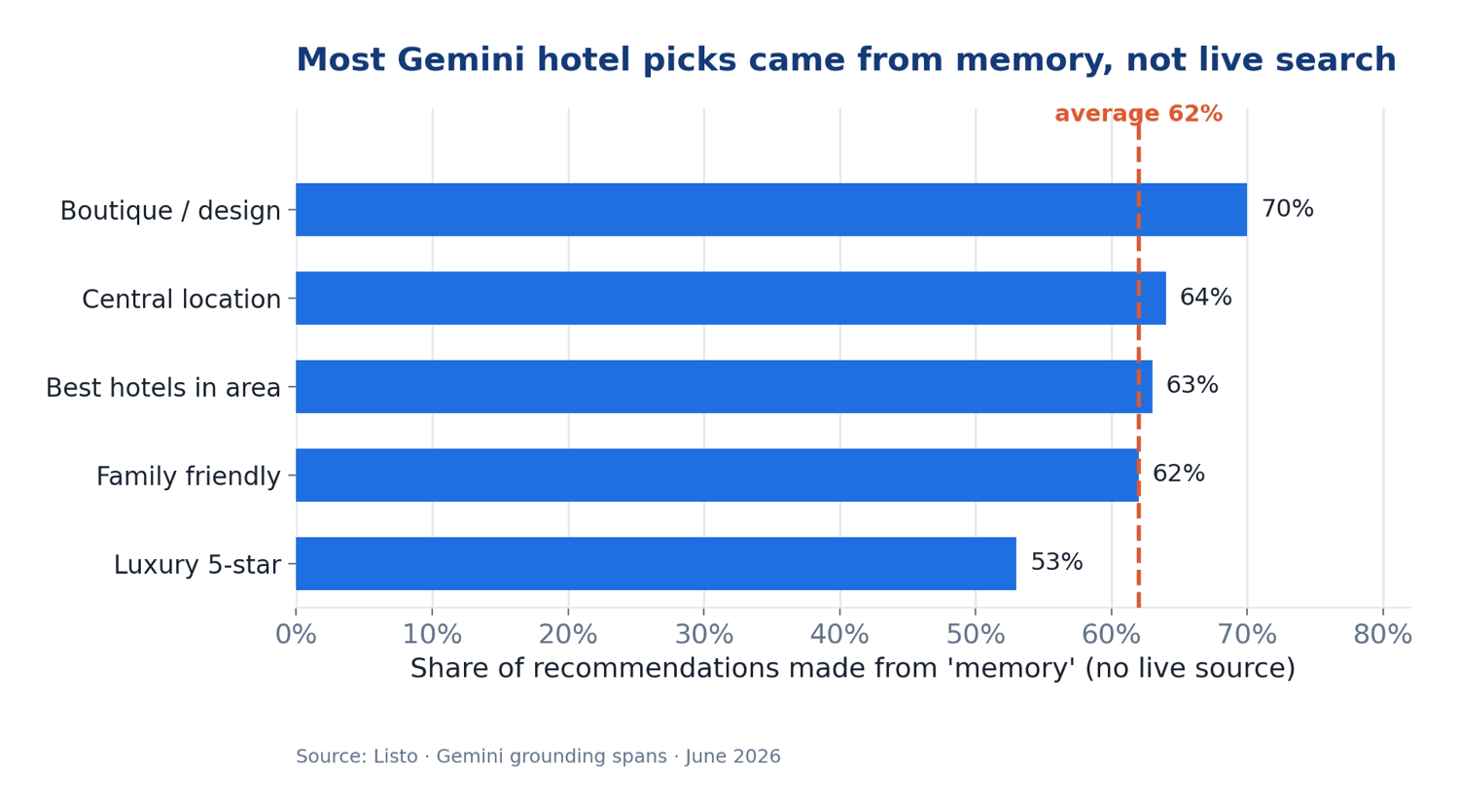
On Gemini, around 62% of recommended hotels were named with no live source behind them at all. The model simply recalled them from what it already "knew" from its training. The pattern held in every single query category we tested. It was weakest for famous five-star hotels (about 53% recalled from memory), which makes sense because the best-documented properties are also the easiest to retrieve information on and confirm live. It was strongest for smaller boutique hotels (about 70%), the kind of property that is less consistently written about online, and where the model leans hardest on memory.
We saw the same behaviour from a different angle on ChatGPT. About 70% of its background searches were aimed at a specific named hotel's official site, queries like "{hotel name} official." In other words, ChatGPT appears to decide which hotel to recommend first, drawing on what it already knows, and then searches to confirm it.
This changes the game. Whether your hotel even enters the conversation is partly decided by your long-term presence across the web: the reviews, mentions, articles and listings that accumulate over time and end up baked into how these models "remember" the world. That is not something you can switch on in a day. It is a compounding asset, and the hotels building broad brand presence everywhere now are quietly building an advantage that is will become table stakes in the not so distant future.
But there is a surface you actually control
If the memory finding feels daunting, here is the encouraging counterpart. There is one surface a hotelier owns outright, and the data says it matters enormously: your own website.
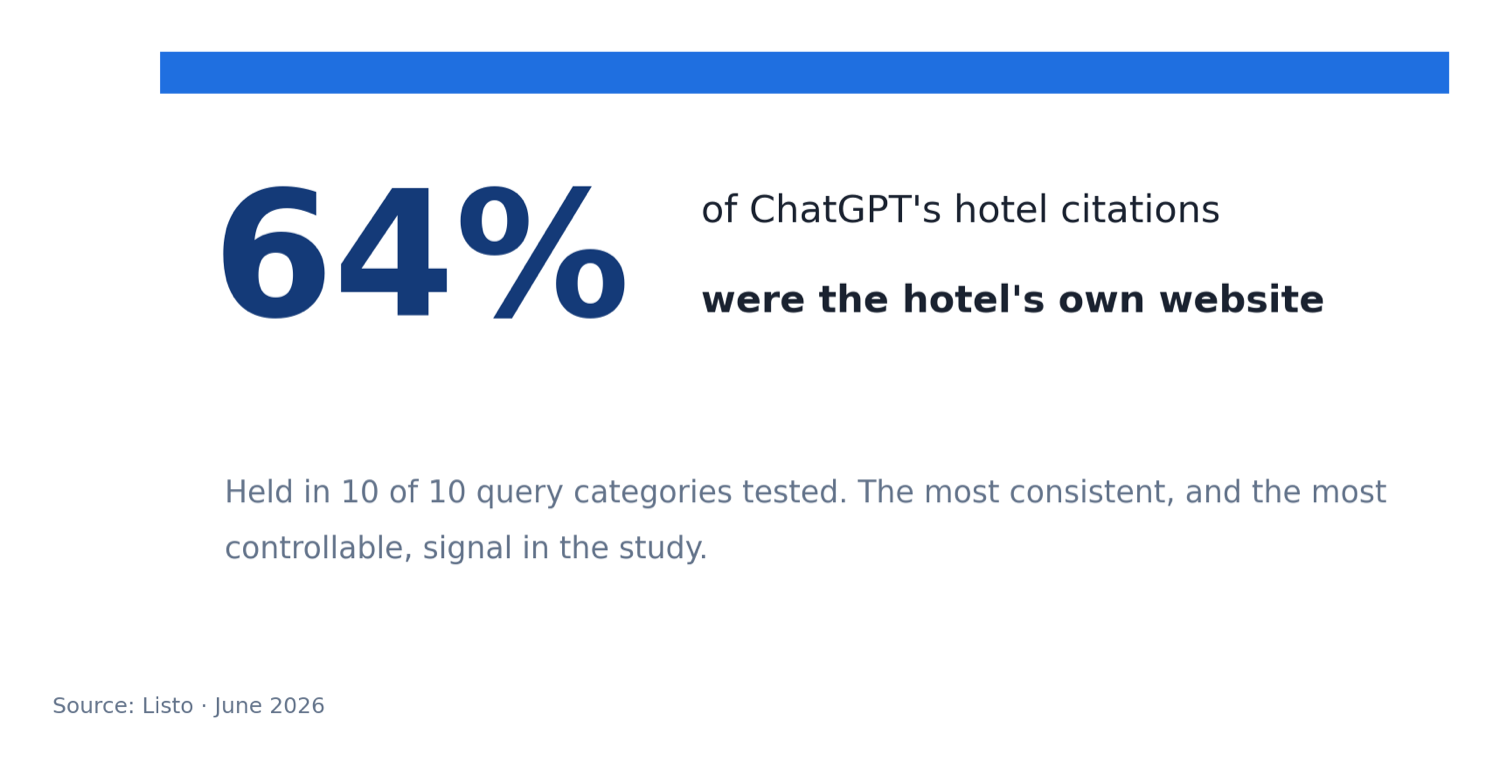
ChatGPT's single largest source of citations, by a wide margin, was hotels' own official sites, and that held true in all query categories we tested. Unlike training-data reputation, which you can only influence slowly and indirectly, your own website is something you control completely. You decide what is on it, how it is built and whether a machine can read it. Pair that with the fact that ChatGPT accounts for nearly 90% of AI assistant usage worldwide (Graphite, 2026), and that makes your own website the most winnable surface in AI search, and the one every hotelier should be optimising for first.
So the two levers work together. Broad presence everywhere is the long game that gets you into the models' memory. Your own site is the near-term, controllable win that gets you cited and confirmed once you are there. Neglect either and you can lose.
What it means for hoteliers
Three things follow from these findings. Build a broad brand presence across the web, because most of the recommendations happen from memory and that footprint compounds over time. Own and actively optimise your own website, because it is the most cited surface on the most used assistant and the one you fully control. And make sure the basics are right: a server-rendered, machine-readable site is the floor, not a nice-to-have.
One honest caveat from these findings. All results are averages from sometimes wide ranges of output, which varied heavily by type of prompt. The exact percentages of what drives invocation will shift as you change country, language or model, and they will move as the assistants themselves evolve and update their training data. LLMs are a black box, and by definition very little is certain or determined. But continuous experimentation is what helps separate firm conclusions from directional ones. And in our opinion, inaction because data is "only directional" is itself a choice, and usually the wrong one in a fast-moving space. AI search is still being decided. The hotels that treat it as a discipline now, rather than waiting for it to settle, are the ones who will be in the answer when it does.
See how AI sees your hotel
Our free diagnostic scores how visible your hotel is to ChatGPT, Claude, Gemini and Perplexity today, with the priority fixes to win the recommendation.
Free diagnostic →