How your hotel shows up in AI (and why it matters)
Ask ChatGPT, Gemini or Perplexity for a good hotel in a city next weekend and you no longer get ten links to compare. You get one short, confident recommendation and a couple of names that made the cut. For a hotel, the only question that matters is brutally simple: were you one of them? Here is how that decision actually gets made, and what you can do to tilt it.
From a page of results to a single answer
For twenty years, being found meant ranking. You earned a spot on a page of links and let the traveller choose. The assistant breaks that habit. Ask it for a hotel and it does the choosing first, then hands back a shortlist of two or three names with a sentence on each. There is no page two to claw your way onto. In fact there is no page at all.
"Only 0.63% of users click results on the second page of Google." (SearchAtlas)
If almost nobody scrolled to page two, almost nobody expands a shortlist either. You are in the answer or you are invisible, and for a hotel that line is the whole game.
The three layers behind the answer
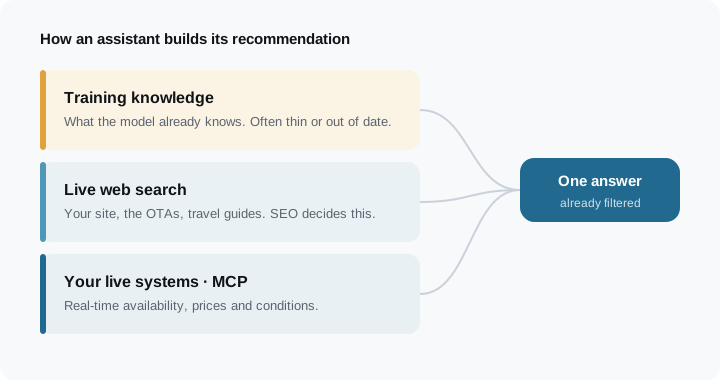
When an assistant recommends a hotel, it is not reading one database. It is blending three sources at once, and each one is a different fight.
- What the model remembers. Its training data, frozen months ago. A global chain is well represented here; an independent hotel is usually thin, generic or simply out of date. You cannot edit this layer directly, but everything you publish now becomes the raw material for the next model.
- What it retrieves live. When the model is unsure, it searches the web in real time and reads what it can: your site, the OTAs, review platforms, travel guides. This is where classic SEO and structured data decide whether the assistant can understand you at all. If your rates and availability sit behind a script a crawler cannot run, you disappear at the exact moment that counts.
- What it pulls straight from you. The newest layer. Through a connected data layer (an MCP), an assistant can query your live availability, prices and conditions directly, the way it already does with Booking and Expedia inside ChatGPT. This is the difference between being described and being booked.
Most hotels compete, almost by accident, in the first layer only, and ignore the two they can actually control.

A booking, traced step by step
Picture a real request: "find me a boutique hotel in San Sebastián for two nights in October, walking distance to the old town." Here is what happens in the seconds before the answer appears.
- The model reads the intent: boutique, a city, dates, a proximity constraint.
- It checks what it remembers, and finds maybe one or two well-known names.
- It runs a live search to fill the gaps and confirm the details, reading only what it can parse.
- It assembles three options it is confident about and writes a short paragraph for each.
Now picture where most hotels fall out. The assistant could not confirm how far you are from the old town, could not read your room types, and found your rate only on an OTA. So it cites the OTA, recommends the property whose facts it could verify, and the direct relationship with that guest never happens.
This is a distribution problem, not a marketing one
When an assistant cannot read or trust your data, it does not give up. It leans on the sources it can read, and those are the OTAs. Whatever Booking and Expedia say about you becomes the story the model tells. The same dependency that search created with the OTAs is quietly reforming inside the AI channels, one recommendation at a time.
The hotels pulling ahead are not the ones with the most beautiful website. They are the ones with the most legible, verifiable, connected data. Clarity beats polish, because the reader is now a machine.
What you can do this quarter
- Make your facts machine-readable. Add structured data (schema.org) for your property, location, ratings, amenities, policies and prices, so the model reads them without guessing.
- Open the door to AI crawlers. Publish an
llms.txtand allow GPTBot, ClaudeBot, PerplexityBot and the rest in your robots.txt. Blocking them is the simplest own goal in the channel. - Publish answers, not brochures. Write clear, verifiable content for the questions guests really ask: exactly where you are, what is included, how cancellation works.
- Connect your live data. An MCP layer that exposes real-time availability and rates is what moves you from "mentioned" to "bookable".
None of this means rebuilding your technology. It means exposing what you already have in a form an assistant can understand and trust, before the hotel next door does. At Listo, that is the entire job: making sure that when an assistant decides on a guest's behalf, it can find you, read you, and book you.
How does AI see you right now?
Run a free diagnostic and see how your hotel appears to ChatGPT, Claude, Gemini and Perplexity, with your priority fixes.
Free diagnostic →