What is an MCP, and how it lets AI book your hotel
Good content and GEO can get an assistant to mention your hotel. But a mention is not a booking. The piece that turns "ChatGPT recommended you" into "ChatGPT booked you" is a quieter, more technical thing called an MCP. Here is what it is, and why it is about to matter to every hotel.
From being recommended to being booked
The last few years of AI work have been about visibility: getting models to know you, trust you, and recommend you. That is necessary, but it stops at the door. When a guest is ready to check a date, see a real price, or actually reserve, the assistant has to do something it cannot do from a web page alone. It has to talk to your live systems.
That conversation needs a common language. An MCP is it.
So what is an MCP, exactly?
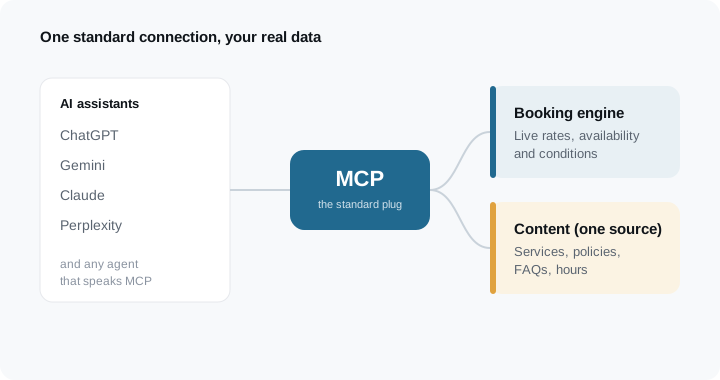
MCP stands for Model Context Protocol. It is a standard way for an AI assistant to connect to your systems, read live information, and take actions, without scraping your website or someone building a bespoke integration for every model.
Think of it as a single, well-labelled plug. Build it once, and any assistant that speaks the standard (ChatGPT, Gemini, Claude and the rest) can use it. It does not replace your booking engine, your PMS or your CRM. It sits in front of them and exposes, in a form a model can understand, what they already know.
Two things make it powerful. It is standardised: one connection, many assistants. And it is authoritative: the data comes straight from you, not from a third party's best guess.
What it connects, and what it unlocks
An MCP typically bridges two kinds of information:
- Live transactional data. Real-time availability, rates, inventory and the commercial rules around them. This belongs in your booking engine, the only place that knows what is actually for sale right now.
- Operational content. Your services, policies, opening hours, what is included, the answers to the questions guests really ask. This belongs in a single, canonical source, so every channel tells the same story.
With both connected, the assistant stops guessing. It can confirm a room is free on the guest's dates, quote the real price with your conditions, complete the booking, send an invoice, or sell a late checkout, all inside the conversation the guest is already having. That is the leap: from being described to being transacted with.

Three ways an assistant reaches a hotel today
Right now there are three routes, and they are not equal.
- The API route. The assistant talks to a structured interface, the way some already do with the big OTAs. Fast and reliable, but it means a separate integration per platform, which quietly favours whoever has the budget to build them all.
- The web route. The assistant browses your site like a person would, clicking through your booking flow. Flexible, but slow, fragile, and only as good as how machine-readable your site is.
- The MCP route. A single standard connector built for assistants. It is the newest of the three and the one the ecosystem is converging on, because it scales: one connection that every model can use.
As assistants multiply, building a bespoke link to each one stops making sense. A standard does.
Why this is the moment that decides who owns the guest
The stakes here are about distribution, and they should feel familiar. If a hotel does not expose its own connected, authoritative data, the assistant reaches for the source that has: the OTAs. Whatever Booking and Expedia can answer becomes the answer, and a new layer of intermediation, and commission, quietly forms inside the AI channel.
The hotels that connect their own systems keep the direct relationship. The ones that wait hand it to the aggregators a second time, the same way they did with search. This is not a marketing project. It is a distribution one.
What a hotel needs to be ready
You do not need to rebuild your stack. You need four things lined up:
- A single source of truth for your content, so every channel and assistant tells the same, correct story.
- To close the content gap. Your website probably shows a small fraction of your operational reality; an assistant needs the rest to answer well.
- Your transactional systems connected, so live availability and rates can flow, not just static facts.
- An MCP built and maintained now, before the assistants settle on whom they trust, rather than after.
The early movers will be the names assistants reach for by default, and that position compounds.
At Listo, this is the layer we build: the connection that turns AI visibility into real, direct bookings, on your terms rather than an OTA's. The assistants are already learning to act. The only question is whether, when one of them goes to book a hotel, it can reach yours.
Is your hotel ready to be booked by AI?
Our free diagnostic shows how visible and connected your hotel is to AI assistants today, with the priority fixes to get there.
Free diagnostic →