The Anatomy of a Question: How Every Word You Add Changes Which Hotels AI Recommends
Nobody actually types "best hotels" into an AI assistant. A real traveller asks something like "best hotels in Barcelona with a rooftop pool, around €200 a night, for a couple in October". Every one of those details adds another condition to the list. But how do filtering conditions actually affect what happens inside the machine? When a traveller adds one more condition to their question, does the AI trim the answer it was already going to give, or does it build a different answer entirely?
That is exactly what we tested. We built a complexity ladder: the same underlying request, "best hotels", rendered at rising levels of detail, from the bare two-word version up to a realistic five-condition prompt, adding one thing at a time. City, then a pool, then a rooftop pool and a spa, then budget, season and travel party. We held everything else constant, English questions, Barcelona as the destination, a UK-based searcher, so the only variable was the number of conditions in the question. We ran the ladder through ChatGPT, Claude and Gemini, repeating each prompt enough times to separate signal from the assistants' natural randomness. That came to 670 conversations, 6,702 hotel recommendations and 4,014 cited sources. Here is what the data shows.
Every condition rewrites the answer
Each condition a traveller adds does not narrow the previous list, it produces a substantially new one, and the effect compounds with every step.
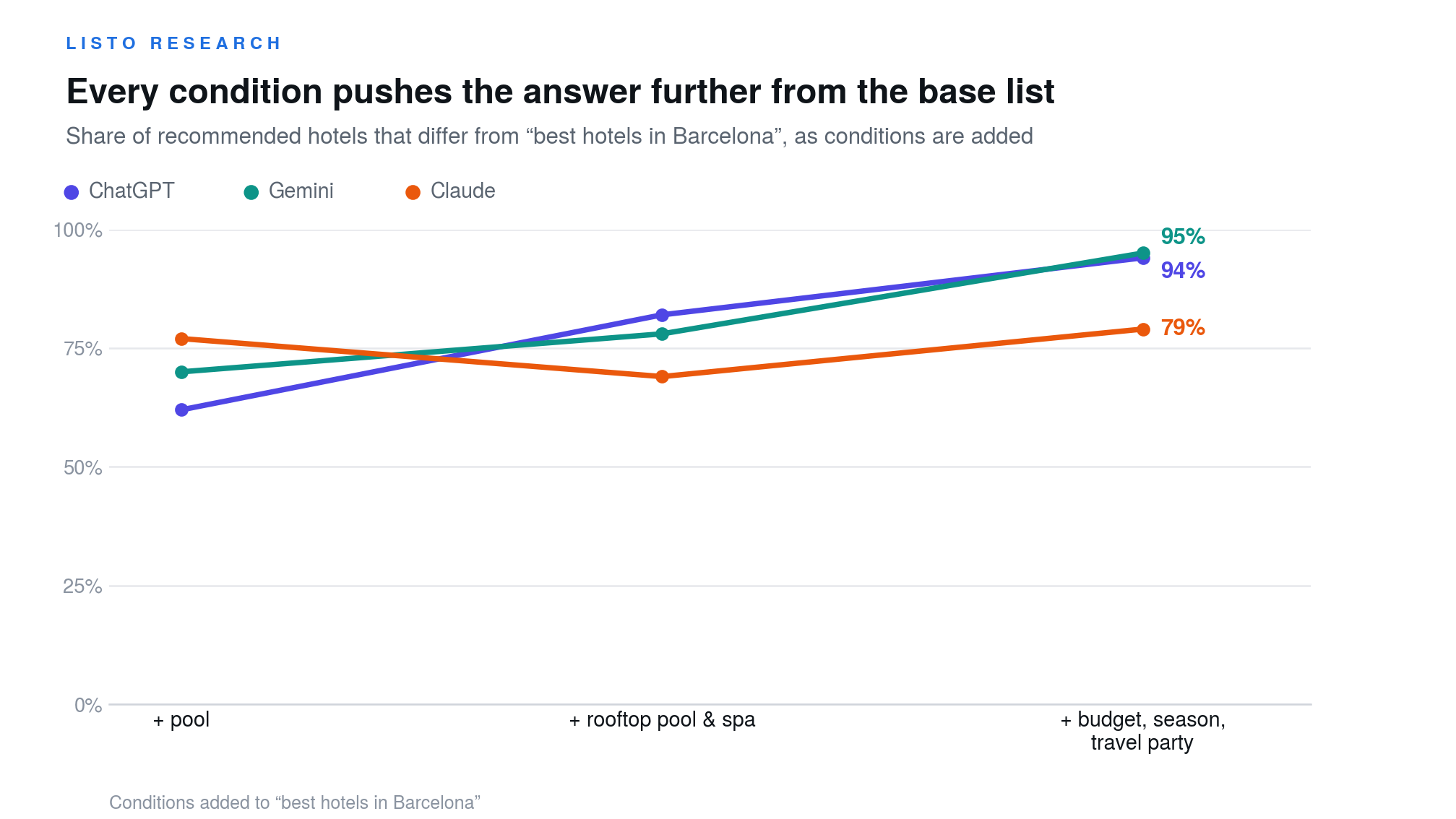
Measured against the base question "best hotels in Barcelona", adding a single amenity already replaced 62% of ChatGPT's recommendations and 70% of Gemini's. By the full real-world prompt, with budget, season and travel party included, 94% of ChatGPT's and 95% of Gemini's recommended hotels were different from the base list. Claude showed the same rung-to-rung reshuffling, just less tidily, its lists were noisier between steps. And at every single rung, on every assistant, the number one recommendation changed. No assistant kept the same top pick from "best hotels in Barcelona" once a pool was added, and it flipped again with each further condition.
One reason this happens is visible in the machinery. Behind every answer, the assistant runs its own background searches (called "fan-out queries"), and the condition the traveller added showed up in those searches 100% of the time, on every assistant, at every rung. The question's conditions literally become the searches. Change the question, and you change what the assistant reads.
The practical reading: there is no single list your hotel is on or off. There is a different contest at every level of specificity, with different winners each time.
Which condition matters as much as how many
Complexity is not one dial that goes from vague to specific. Each individual condition steers the answer independently.
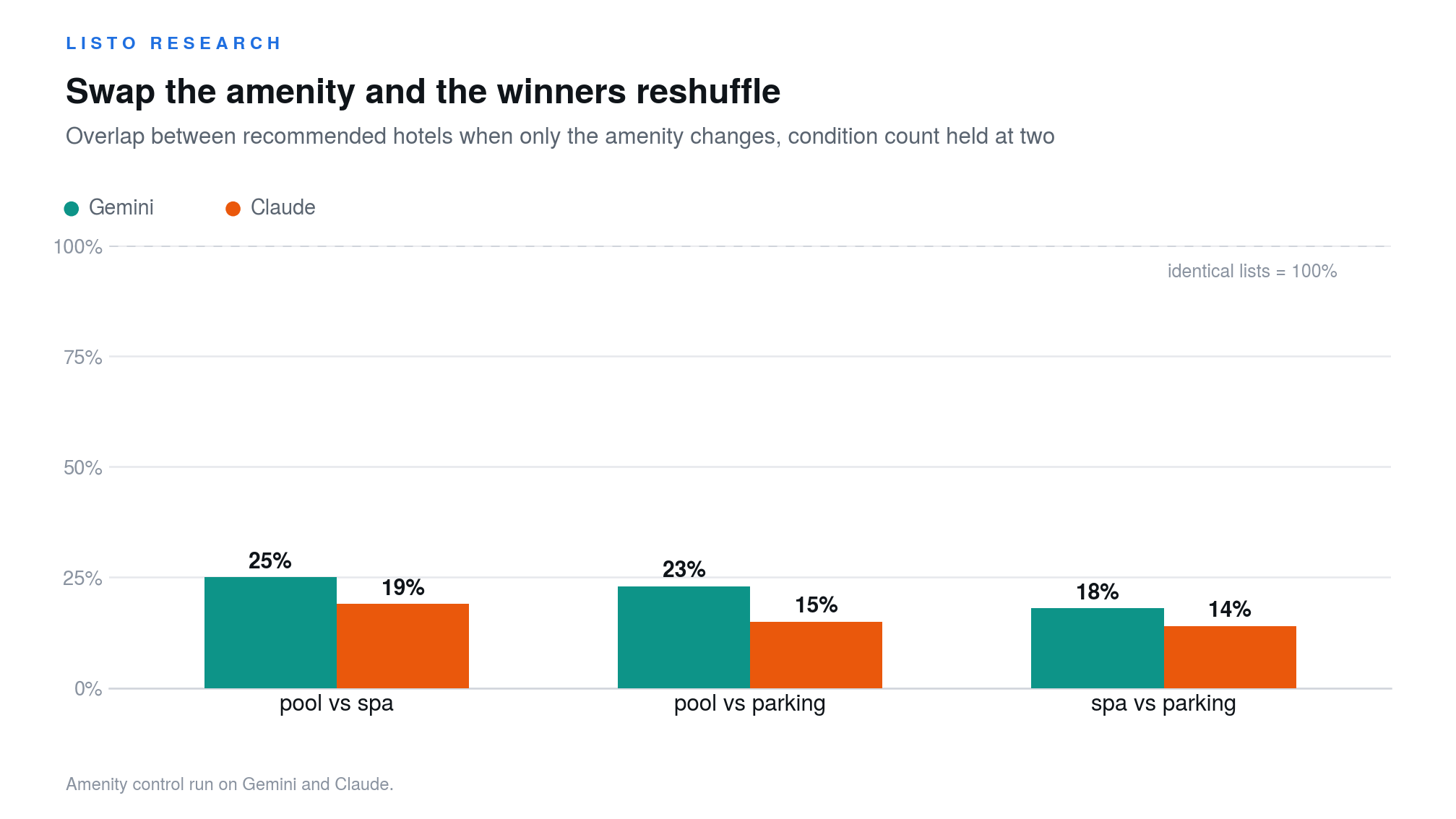
We tested this directly by holding the question at exactly two conditions and swapping only the amenity: a pool, a spa, or parking. The recommendation lists overlapped just 14% to 25% with each other. Swapping which condition the traveller names reshuffles the winners almost as much as adding one first condition does.
This is quietly good news for smaller properties. A hotel that never appears for "best hotels in Barcelona" is not locked out of AI search. It can still win "best hotels in Barcelona with a rooftop pool", because that is a different contest with different entrants. Visibility is won amenity by amenity, question by question, not once for the whole city.
The more specific the question, the more your own website decides it
The finding with the most direct consequence for hoteliers is what specificity does to the sources the assistants cite.
On the bare question, ChatGPT built its answer almost entirely from third-party editorial, the familiar "best hotels in the world" listicles, with hotels' own websites making up just 11% of citations. Add the city and own-site citations rise to 29%. Add a single amenity and they jump to 87%, while editorial's share collapses from 88% to 12%. The same direction held on Gemini (5% to 29%) and Claude (0% to 33%), if less dramatically. And at the full booking-shaped prompt, OTA pages re-entered the mix, exactly where you would expect booking intent to surface.
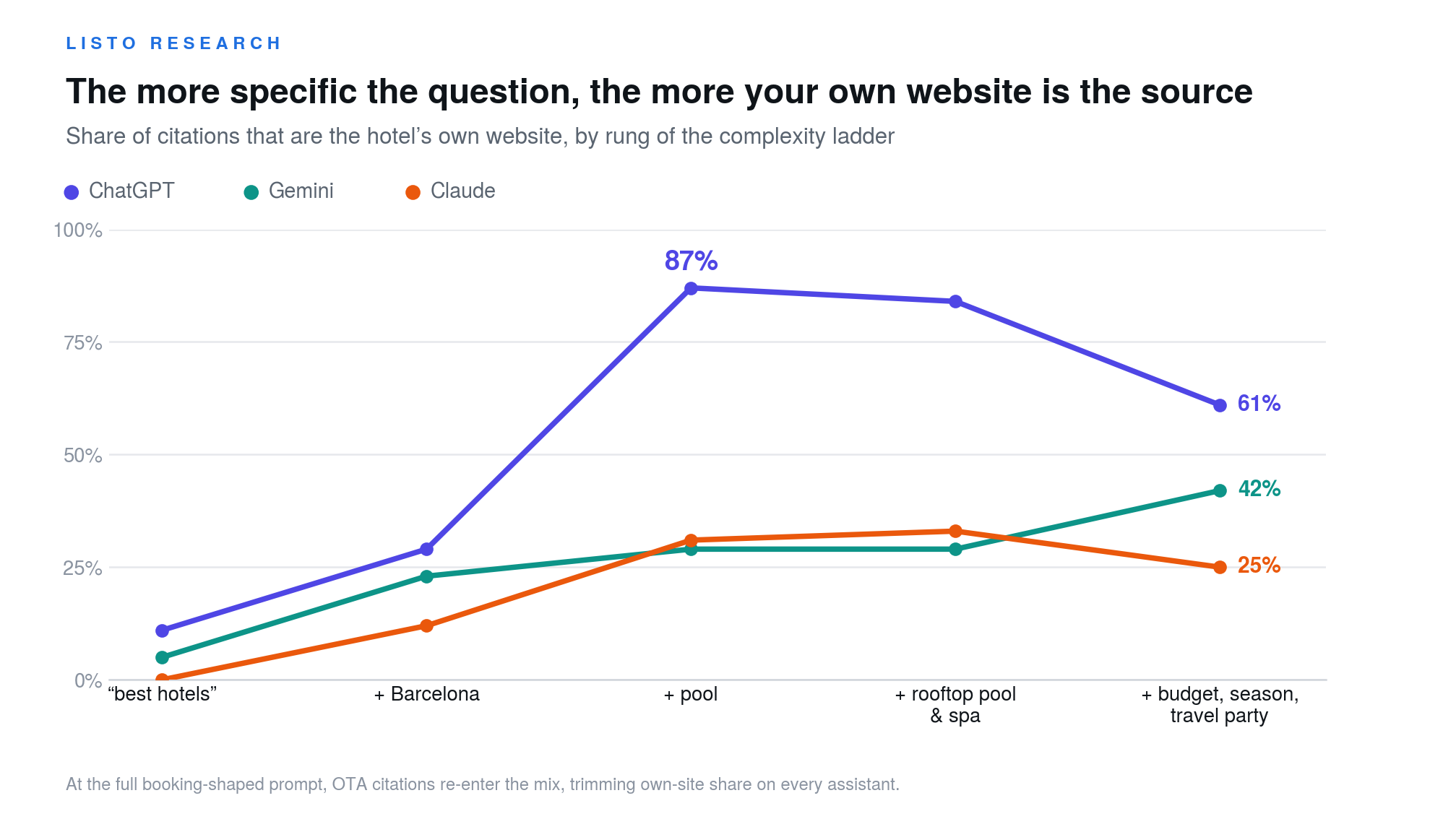
The mechanism is intuitive once you see it. A listicle can tell the assistant which hotels are well regarded, but it cannot reliably confirm whether a specific property has a rooftop pool. For that, the assistant goes to the hotel's own pages. This extends the central finding of our first research post: your own website is the most controllable surface in AI search, and the moment a traveller gets specific, it becomes the decisive one. If your amenities, rates and practical details are not clearly stated and machine-readable on your own site, you are invisible precisely when the traveller is closest to booking.
Most questions are vague. The valuable ones are not
So how often are travellers actually this specific? Less often than you would think. In a large public dataset of real accommodation prompts, roughly 69% were bare, 20% added one condition, and only around 11% carried two or more. The specific, multi-condition question is the exception.
But it is the exception that books. The bare and city-only questions, where most volume sits, are won on editorial coverage, the "best hotels in Barcelona" round-ups that assistants lean on when they have nothing to verify. The specific tail is won on your own website. These are two different games played on two different surfaces, and the data says a hotel needs both: editorial presence for the high-volume vague questions that decide whether you enter the conversation at all, and structured, machine-readable content on your own site for the specific questions where the recommendation actually converts.
What it means for hoteliers
Three things follow. Be present in the editorial round-ups for your destination, because that is where the high-volume vague questions are decided. Make your amenities, pricing context and practical details explicit and machine-readable on your own website, because that is what assistants read the moment a traveller names what they want. And stop thinking of AI visibility as one ranking, because there is a separate contest at every level of specificity, and the winners change at each one.
See how AI sees your hotel
Our free diagnostic scores how visible your hotel is to ChatGPT, Claude, Gemini and Perplexity today, with the priority fixes to win the recommendation.
Free diagnostic →