Lost in Translation: How Prompt Language Changes Which Hotels AI Recommends
Hoteliers and agencies have started asking a sensible question: when a traveller asks an AI assistant where to stay, do we show up? But there is a dimension to that question that quietly gets missed. Your guests do not all search in the same language. A hotel in Barcelona, for example, is found by Spanish, English and French travellers, and people tend to ask in their own language. So when an English traveller looks for somewhere to stay in Spain, are they shown the same hotels, and pointed at the same sources, as the Spanish guest asking the exact same thing?
It is an easy thing to overlook, and a relevant one if you are trying to be visible to guests from more than one country. So we tested it. We took twelve real hotel questions, translated each into Spanish, English and French with identical meaning, and asked all three to ChatGPT, Claude and Gemini, enough times to build robust findings. We held the destination constant (Barcelona) and the place we searched from constant (Spain), so the only thing that changed was the language of the question. This came out to 540 conversations and 3,710 cited sources. Here is what the data shows.
The language you ask in is the hidden lever
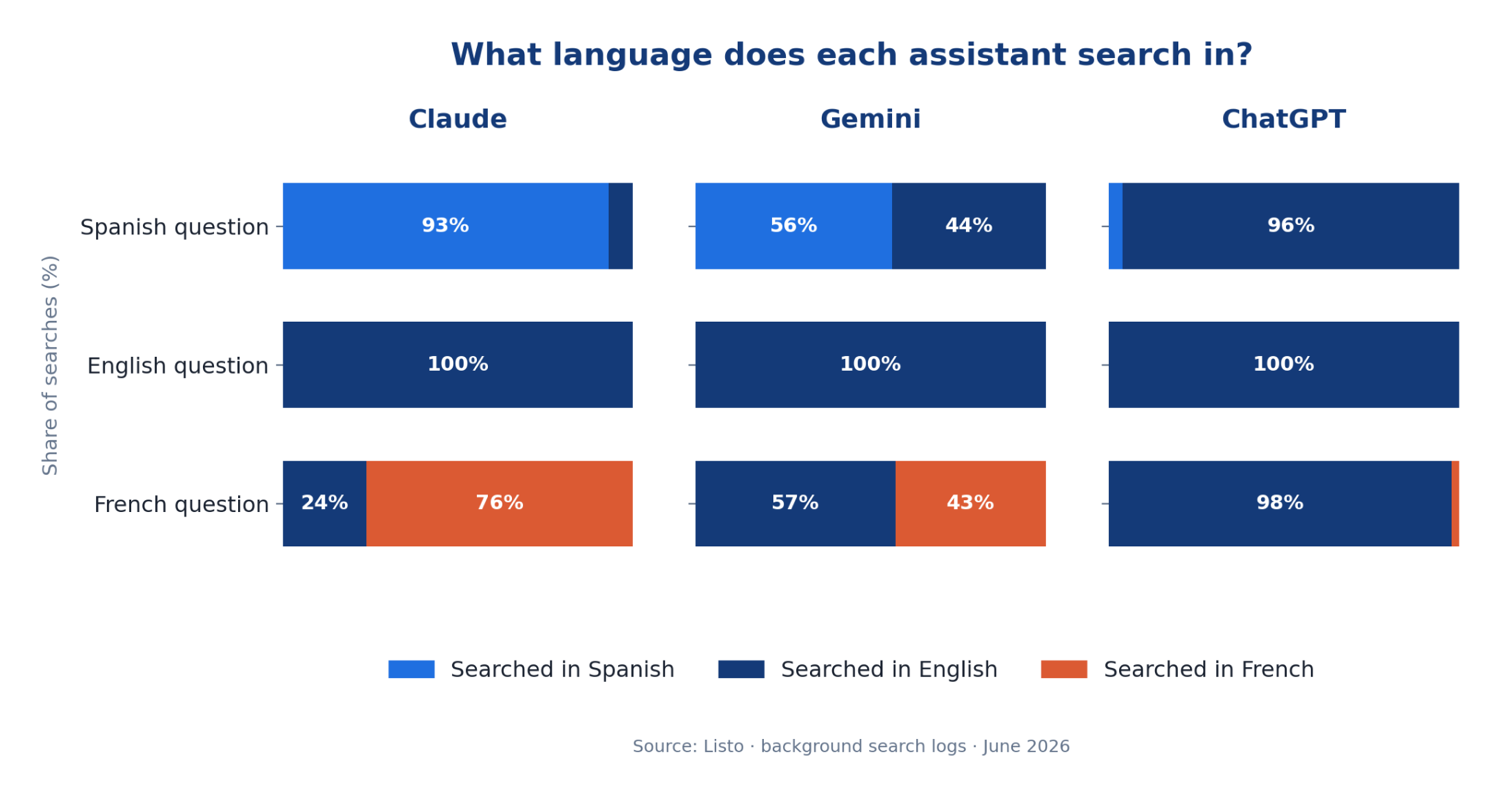
Behind every answer, an AI assistant runs its own web searches, and the language those searches are written in decides what the assistant brings back.
The three platforms' assistants handle this very differently. Claude searches in whatever language you asked in: ask in Spanish and it searches in Spanish 93% of the time, ask in French and it searches in French 76% of the time. ChatGPT does close to the opposite, quietly translating almost every question into English and searching the English-language web whatever language you used, between 96% and 100% of the time. Gemini sits in between, searching in your language about half the time.
This matters because the web an assistant searches is the web your hotel has to be visible on. If it is reading the Spanish web, your Spanish-language presence is what counts. If it is reading the English web, that is the room you need to be in.
Different language, different hotels
Because the assistants search different webs, they hand back different hotels.
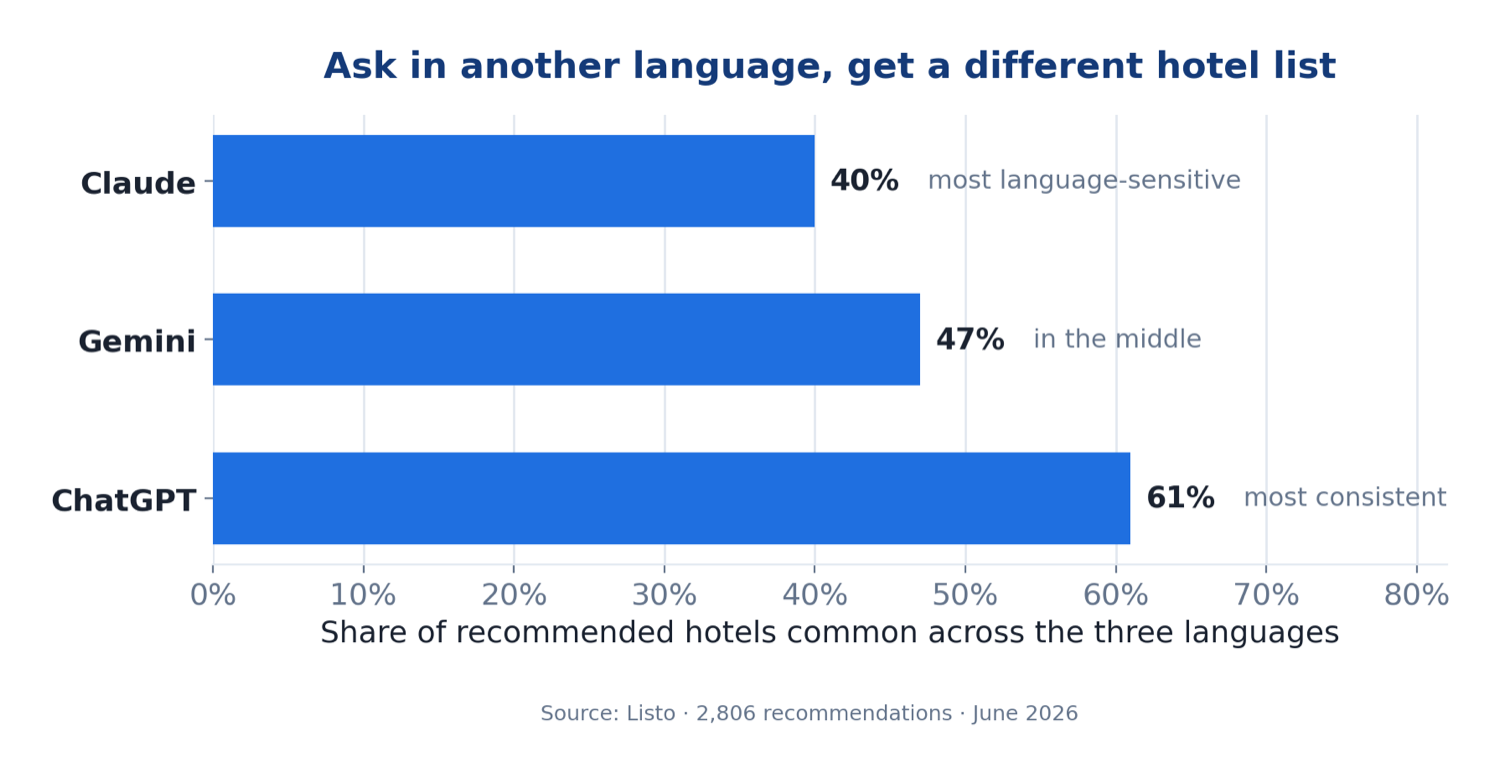
We measured how much of each assistant's recommended list stayed the same across the three languages. Claude's list overlapped just 40% from one language to the next, the most language-sensitive of the three. Gemini sat at 47%. ChatGPT, routing everything through English, was the most consistent at 61%.
The very top of the list is stable. The famous names, Mandarin Oriental, Hotel Arts, the Majestic, get recommended in all three languages by every assistant. What moves is the ranking and the middle of the list, the long-tail of hotels that make up most of the market. The practical reading is simple: a hotel can be a confident pick when the question is asked in one language and slip down the list when it is asked in another. You cannot win it once, in one language, and assume it carries.
The kind of source you need to win stays the same
Here is the reassuring part, and the start of an answer to the question we set out with.
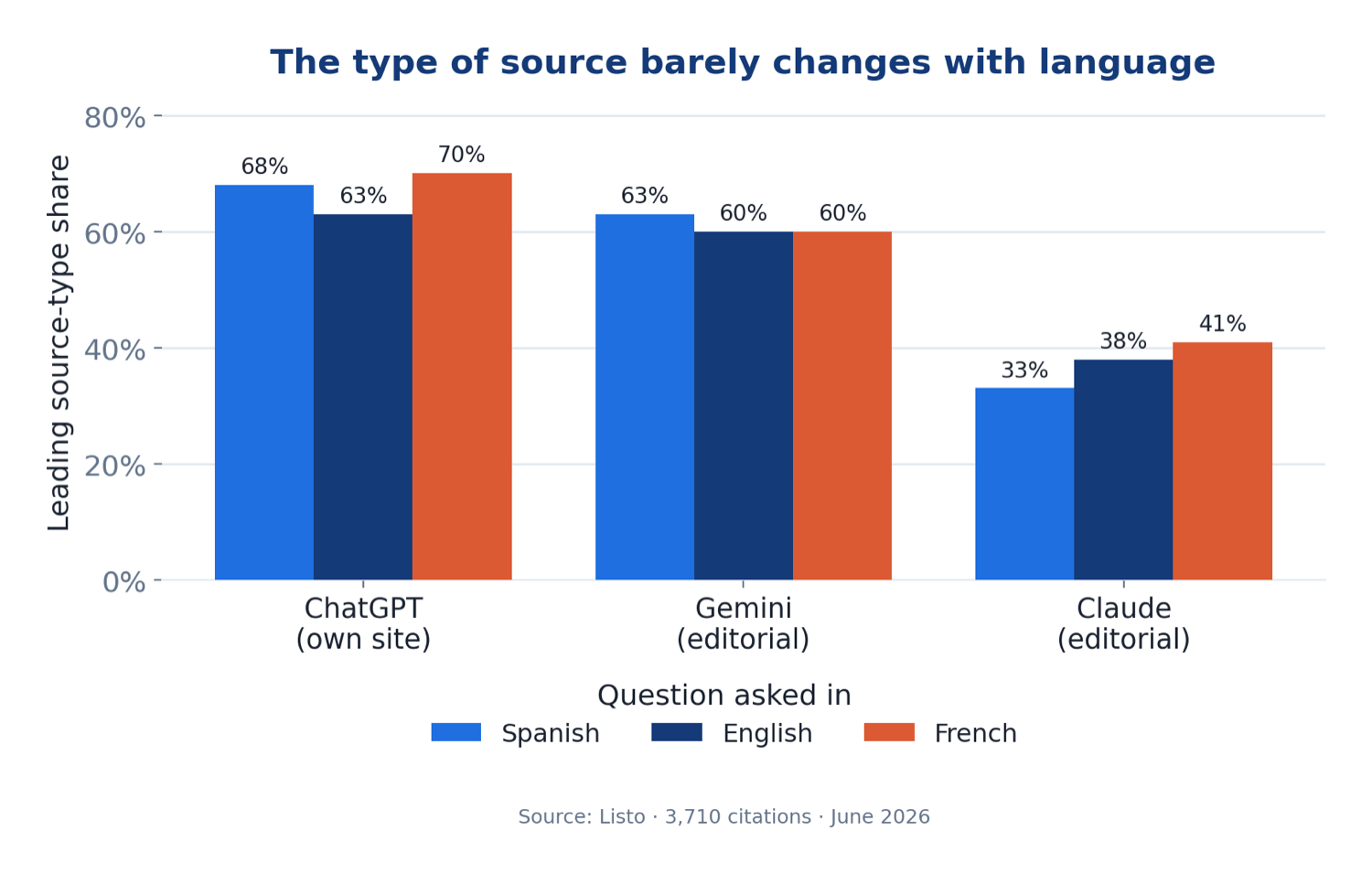
While the specific hotels move, the type of source each assistant trusts barely moves at all. ChatGPT cites the hotel's own website around 67% of the time, in every language. Gemini leans on editorial media, around 60%, in every language. Claude is more mixed but editorial-leaning. OTAs like Booking and Expedia stay a minority throughout.
In other words, the kind of surface you need to win is something you can decide once. Whatever language your guest uses, the way to show up on ChatGPT is a strong own website, and the way to show up on Gemini and Claude is editorial coverage. That does not change when the language does.
But the specific sources change with every language
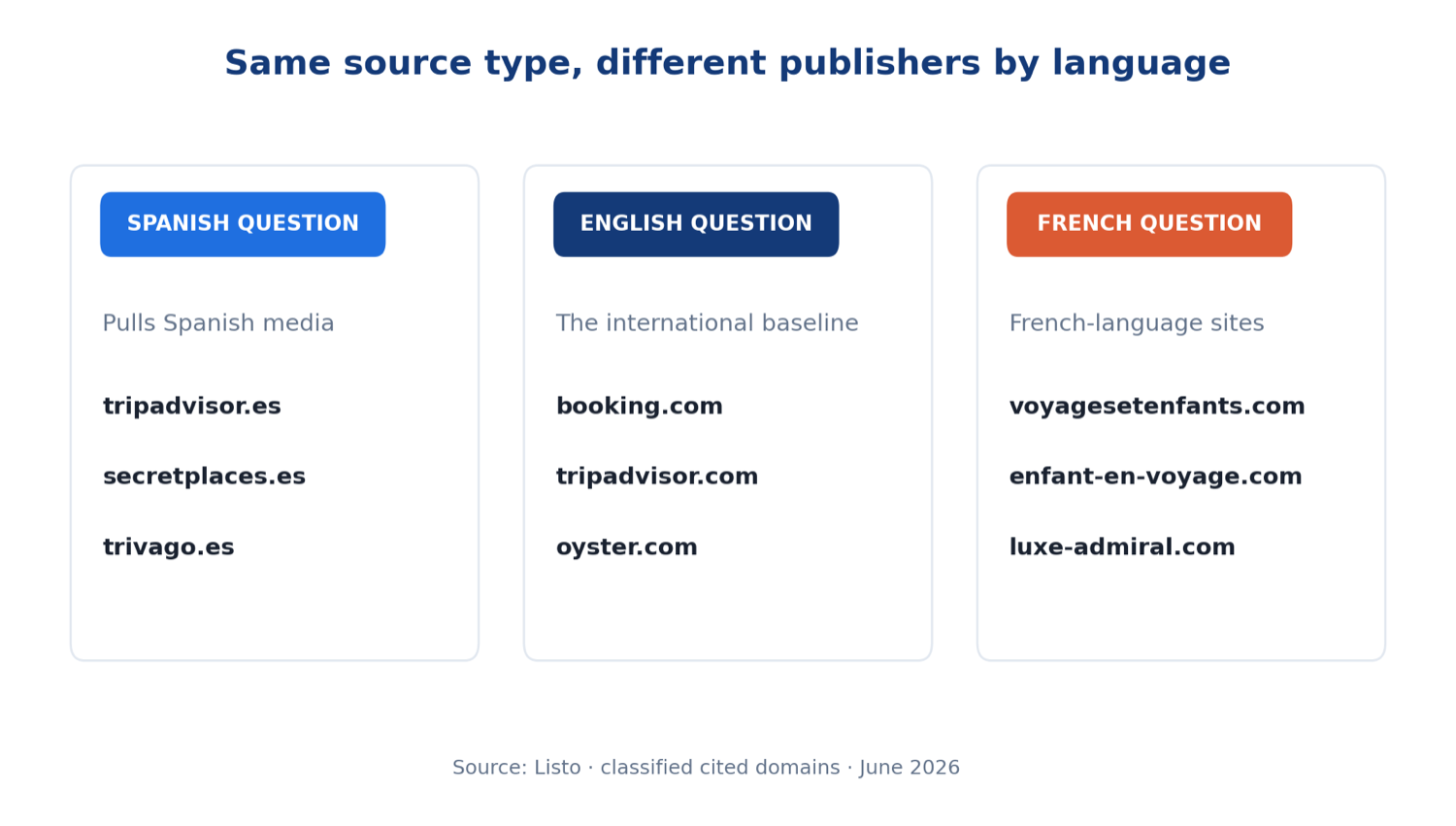
The catch is that "editorial coverage" is not one thing. The type of source holds, but the actual publishers swap out with the language of the question.
Ask in Spanish and the assistants pull Spanish media: tripadvisor.es, secretplaces.es, trivago.es. Ask in English and you get the international .com baseline: booking.com, tripadvisor.com, oyster.com. Ask in French and you get French-language sites, even on .com domains: voyagesetenfants.com, enfant-en-voyage.com. On Claude, around a third of the domains cited for Spanish questions were Spanish .es sites.
This is the part that matters most to a hotelier. To show up for the English traveller or the French traveller searching for somewhere to stay in Spain, you have to be present in their language's media, not just your home market's. Editorial and review presence has to be earned in each guest language, or you are simply not in the room when the question is asked in that language.
What it means for hoteliers
The language of the question a traveller types into an AI assistant is an easy thing to miss, but it's very relevant when your guests come from more than one country. Naturally, for most businesses in travel and hospitality, this is extremely common.
The useful way to frame these findings: the surface you fight for is stable, but the sources you compete on change with every language your guests speak. Decide the surface once, own site for ChatGPT, editorial for Gemini and Claude, then earn the specific publishers per language. A hotel optimised only for Spanish-language media will be under-represented the moment a guest asks in French or English. The takeaway? Fighting for a multilingual web presence is an important part of winning AI visibility in travel.
Are you visible in every guest's language?
Our free diagnostic scores how your hotel shows up across ChatGPT, Claude, Gemini and Perplexity, with the priority fixes to win the recommendation.
Free diagnostic →