What is GEO (Generative Engine Optimization)?
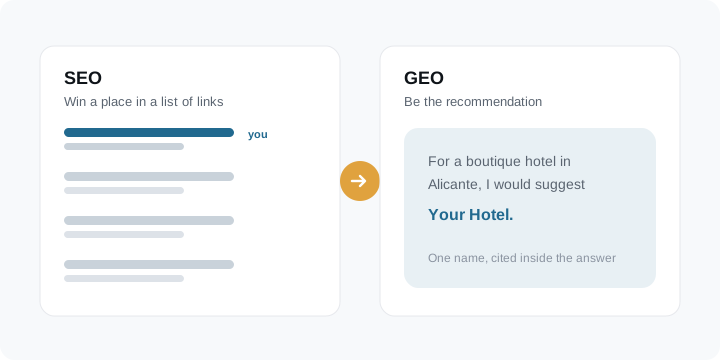
GEO, Generative Engine Optimization, is the practice of shaping how AI models understand, trust and recommend your brand. If SEO was about ranking on a page of links, GEO is about being the answer the assistant gives when there is no page at all. It is the same instinct as SEO, aimed at the systems that are quietly replacing search.
A definition worth getting right
GEO, Generative Engine Optimization, is the practice of shaping how AI models understand, trust and recommend your brand. The generative engines (ChatGPT, Gemini, Claude, Perplexity) increasingly sit between people and the open web: they read, they reason, they answer, and most of the time the user never clicks through to a site at all. GEO is the work of making sure that when one of them speaks about your category, it understands you correctly and recommends you with confidence.
It earns its own name because it behaves differently from the discipline it grows out of. The reader is different, the prize is different, and the rules for winning are different.
How GEO differs from SEO
Three things change at once.
- The reader. SEO optimises for a crawler that indexes and ranks. GEO optimises for a model that reads, reasons and summarises. A crawler tolerates a messy page; a model rewards structure, clarity and facts it cannot misread.
- The outcome. SEO wins a rank you can measure on a page. GEO wins a mention you have to earn inside an answer that is rewritten every time it is asked, and phrased differently for every user.
- The trust bar. A ranking can be nudged with links. A citation has to be earned with verifiability. The model leans on what it can corroborate: structured data, consistent entities, claims it can check against more than one source.
They are not rivals. SEO is still the foundation that lets a model find and read you in the first place. GEO is built on top of it, not instead of it.
Why the ground is shifting now
Two forces are pulling in the same direction. The first is behaviour: answer engines keep users inside the conversation rather than sending them out to click. The old flow, person to Google to website, is collapsing into person to assistant to answer.
The second is money, which always follows attention.
The market for AI-powered search is projected to grow at roughly 50% a year, into the tens of billions of dollars over the coming decade. (DMR)
So the question quietly changes shape. It is no longer "how do I rank on Google?" It is "am I in the model's answer, and is what it says about me actually true?"

How a model decides who to cite
No provider publishes the exact recipe, but the shape of it is consistent, and at Listo we run thousands of tests to map it. Conceptually, a model interprets what the user wants, looks for sources that match that intent and that it can trust, and assembles its answer from the few it is most confident about.
That has a practical consequence. The job of GEO is to make your brand the easiest in your category to understand and the hardest to get wrong. In practice that means four things working together: structured data, clear entities (who you are, what you do, where you operate), content that answers real questions in a verifiable way, and open access for the crawlers that feed the models.
Being seen is not the same as being booked
Being cited is the first prize. The second, larger one is being transactable. As assistants move from answering to acting, the brands wired to be queried and booked directly, through a connected layer such as an MCP, capture the decision from start to finish instead of handing it to an intermediary. We go deeper on that in how your hotel shows up in AI and in the war for visibility.
Where to start
- Measure first. See what AI actually says about you today, and what it cannot find.
- Fix the foundations. Structured data, crawler access, and an
llms.txtso the models can read you cleanly. - Earn the trust. Publish verifiable, answer-shaped content instead of marketing copy.
- Then connect. Expose live data for the moment visibility turns into a booking.
GEO is not a trick you run once. It is the ongoing work of being legible to the systems that now stand between you and your customer. The brands that start early compound an advantage the latecomers will spend years trying to buy back.
Measure your GEO in 30 seconds
Our free diagnostic scores your AI visibility and gives you the priority fixes for your hotel.
Free diagnostic →