Does Marriott really lead AI hotel discovery? We asked four assistants
Ask where the AI shift will hit hotels first and the world's largest hotel company has an answer. "The biggest impact you'll see on our industry," Marriott's CEO Anthony Capuano told investors this month, "is the distribution landscape." Not operations, not pricing. The moment a traveller asks an assistant where to stay and gets a shortlist back.
Marriott is acting on it. Capuano says the company is feeding Google and OpenAI as much content about its portfolio as it can, so that its hotels "show up in a really both authentic but prominent way." Natural-language search is coming to Marriott.com. It is running a sponsored-placement pilot inside ChatGPT. This is a distribution strategy, built for a channel that did not exist three years ago.
Which raises the question every hotel company now has to answer: is it working? Marriott believes it is. Capuano told the same audience that Marriott's portfolio is showing up in these platforms "more readily available than any of our peers," and pointed to outside research to back it up. It is a reasonable thing for the world's largest hotel company to say. It is also, as far as we can tell, the first time a major hotel CEO has cited AI-visibility research as a competitive result. So we checked.
The research he points to, a Lighthouse study, looked at ChatGPT and found Marriott ahead. We wanted to know whether the same holds on the other assistants travellers use, Claude, Gemini and Perplexity, which are built very differently. So we asked all four the same hotel questions in ten cities, 960 answers in total, and credited every hotel they named to the group that owns it.
The short version: on the headline, Capuano is right. In the fine print, the lead is narrower, more fragile and more model-dependent than the sentence suggests. And underneath the Marriott story is a bigger one about how AI recommends hotels at all.
What we did
We wanted a fair, repeatable answer to a simple question: when a traveller asks an AI assistant where to stay in a major city, which of the world's largest hotel groups show up, and which one leads.
So we took the 20 largest hotel groups, from Marriott, Hilton, Accor, IHG and Hyatt through to the luxury and regional operators, each with its full portfolio of brands, and asked ChatGPT, Claude, Gemini and Perplexity for hotel recommendations in ten cities: New York, Miami, London, Paris, Madrid, Rome, Tokyo, Singapore, Dubai and Bangkok. We asked as six kinds of traveller: budget-conscious, a mid-market couple, a family, a business traveller, someone planning an upscale special occasion, and a design-led guest. Every hotel the assistants named was credited to the group that owns it, whether or not the chain word appeared. That gave us 960 answers to score, in September 2026.
Two numbers appear throughout. Mention rate is the share of answers that name at least one hotel from a group. Share of group mentions is a group's slice of every time any of the 20 groups was named. The full method, including what we excluded and why, is at the end.
The headline holds. Marriott is the most-named hotel group.
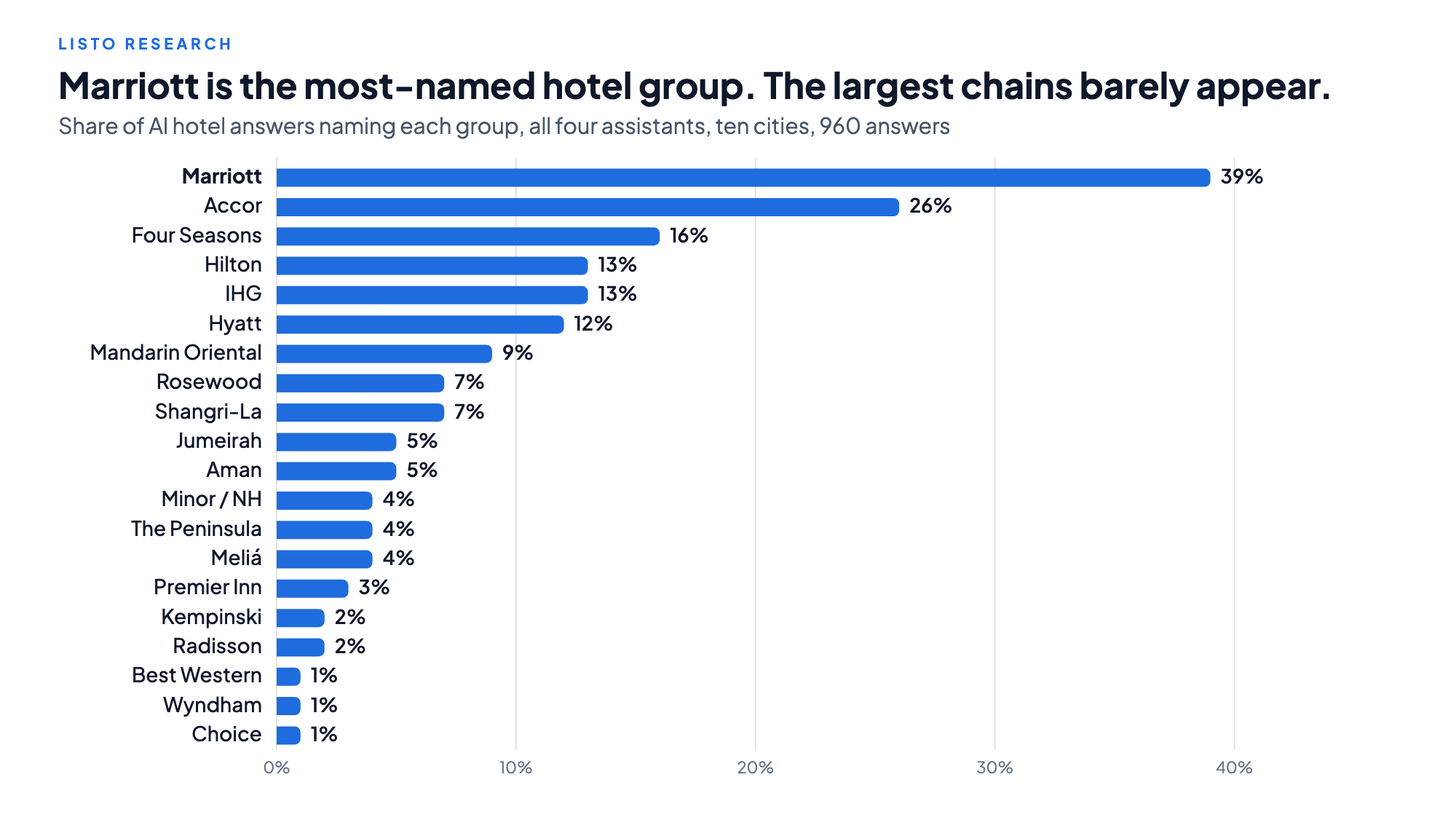
Across all 960 answers, Marriott is named in 39%. Accor is second at 26%, then Four Seasons, Hilton, IHG and Hyatt. The bottom of the ranking in Figure 1 is as telling as the top: Wyndham, Choice and Best Western, which between them run about 21,000 hotels, are each named in 1% of answers. One answer in five names none of the 20 groups at all.
On ChatGPT alone, the assistant most people mean when they say "AI", the picture is the same: Marriott first with 40%, Accor second with 25%. On one assistant, the claim stands as stated. The next section is about the other three.
Then we asked the other three assistants
It does not end there, because the four assistants do not agree with each other about much.
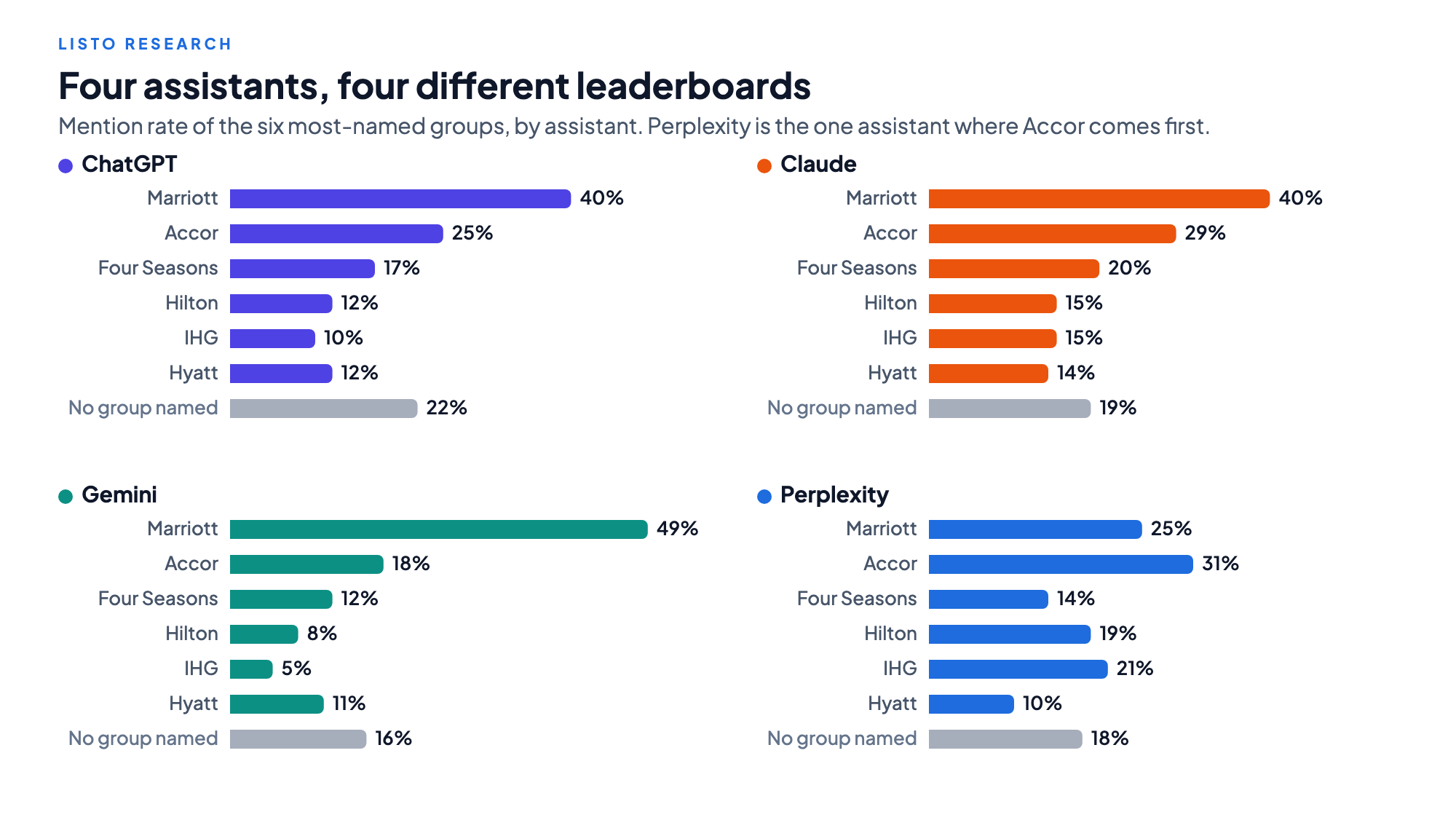
Gemini names Marriott in half of its answers and is the most concentrated market of the four: Marriott alone accounts for 32% of every group mention Gemini makes. Perplexity is the opposite. It names Marriott in one answer in four, puts Accor first, and gives IHG and Hilton more room than any other assistant does.
First on three assistants out of four, and by a wide margin on Gemini, is a strong result. But how far ahead depends on the assistant: 49% on Gemini, 25% on Perplexity, where Accor comes first.
The bigger finding is what happens when you compare the assistants to each other. We looked at how often the four assistants name the same groups when asked the identical question in the identical city. The overlap, measured as the share of named groups they have in common, is 0.13. Only 24% of questions produce even one group that all four assistants agree on. Where at least one assistant names Marriott, all four do so on 15% of questions; on 33% of them, only one does.
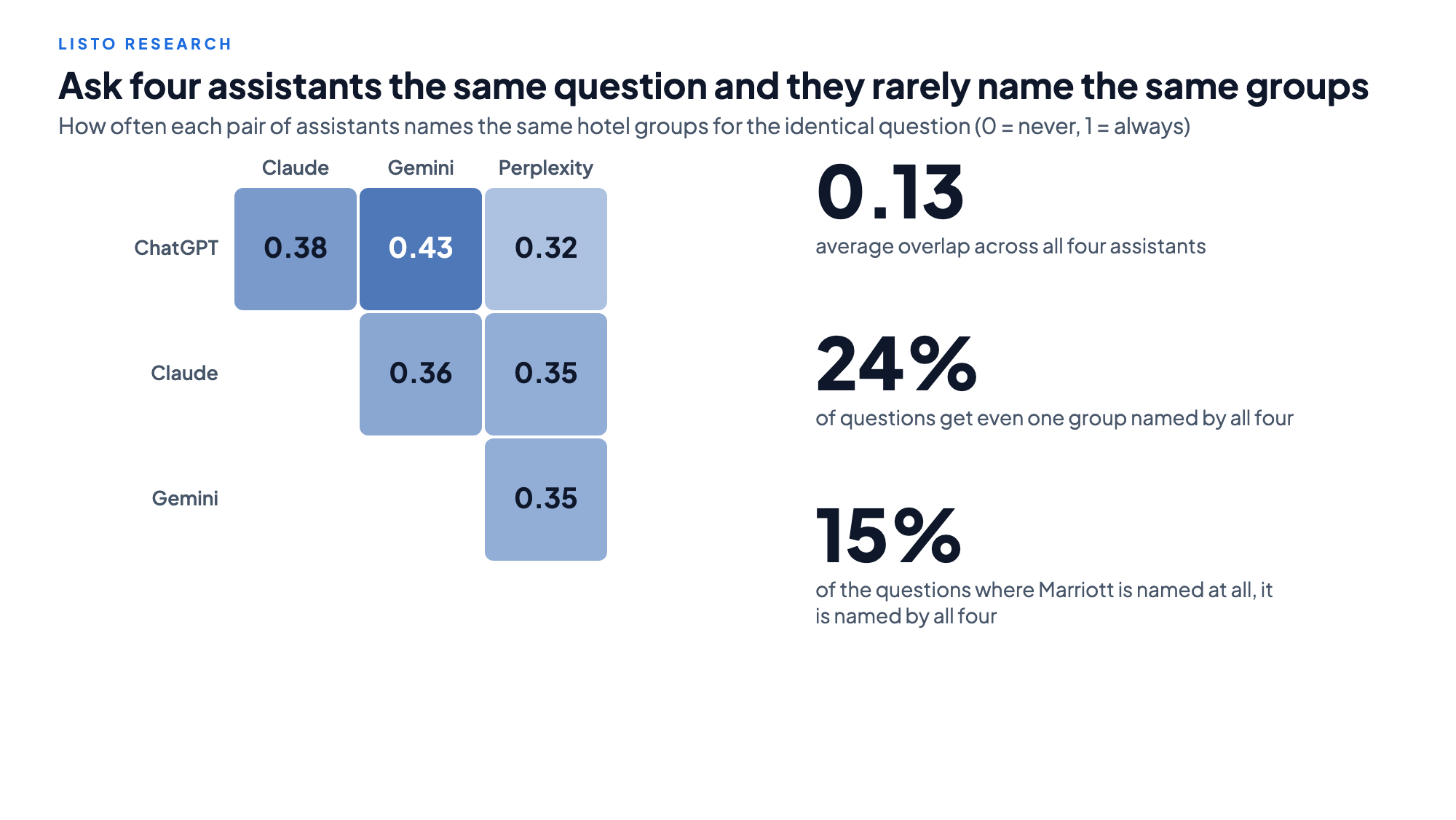
No pair of assistants agrees even half the time. ChatGPT and Gemini are the most alike. Perplexity is the outlier against all three.
This is the finding we think matters most, and it is not really about Marriott. There is no such thing as "AI visibility" in the singular. A hotel that is visible on ChatGPT has learned almost nothing about whether it is visible on Perplexity.
Why four assistants give four answers
They read different webs. We captured every source the assistants cited across the study, and the mix explains most of the disagreement.
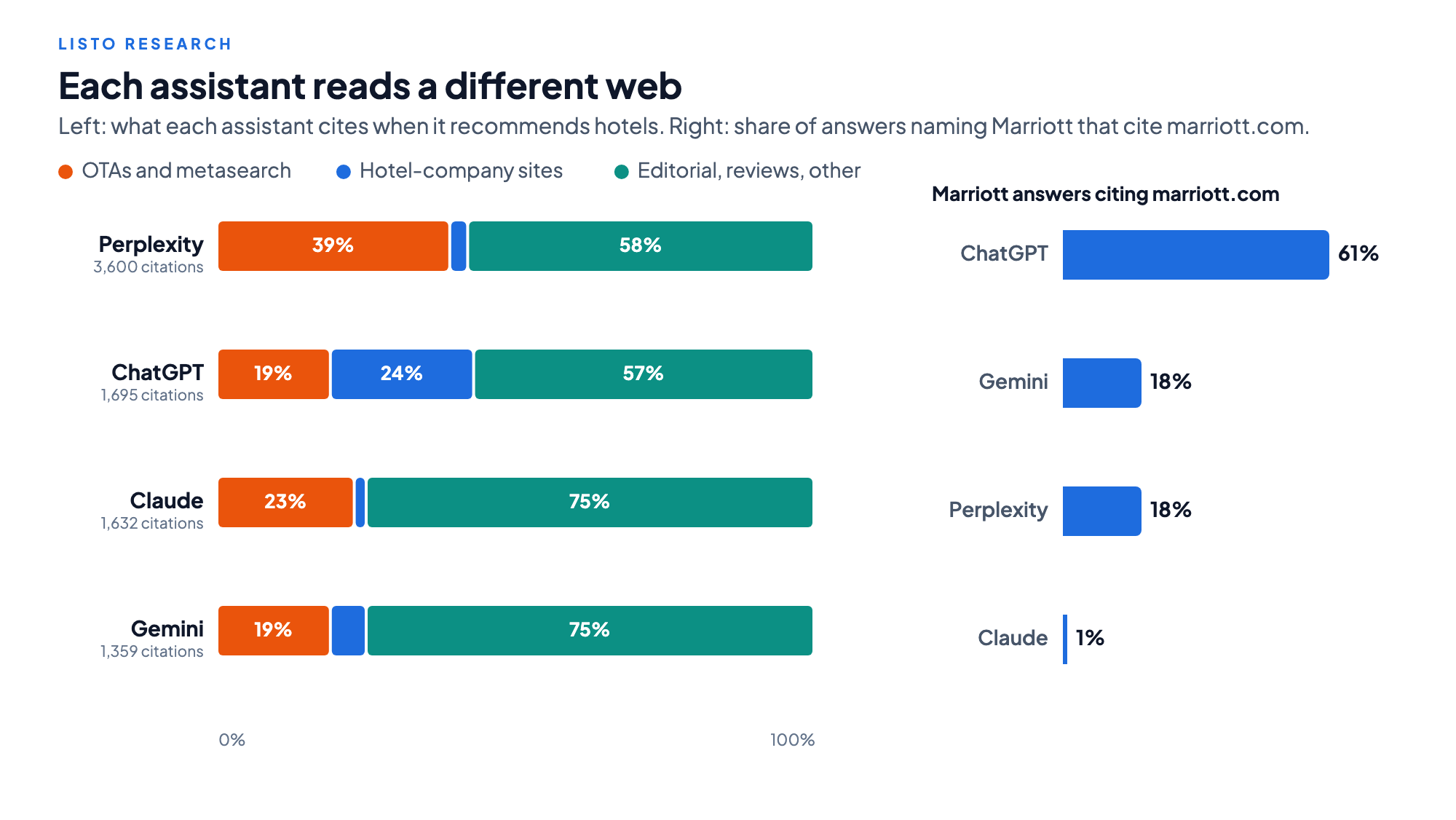
Perplexity cites twice as many sources as anyone else and two in five of them are OTAs. It is reading live listing and review pages, which is why it surfaces the widest set of hotels and the least chain-concentrated one. Tripadvisor alone is cited 520 times. ChatGPT is the only assistant that leans on hotel companies' own websites: marriott.com is its single most-cited domain, followed by Booking.com, Tripadvisor, the Michelin Guide and Condé Nast Traveler. Claude almost never does; it reads review aggregators and editorial. Gemini reads YouTube and Reddit.
One statistic makes the consequence concrete. When ChatGPT names Marriott, 61% of those answers cite marriott.com. On Gemini and Perplexity it is 18%. On Claude it is 1%. Marriott's own-website efforts pay off on one assistant and barely register on the other three.
Inside the Marriott number
Marriott operates roughly 9,700 hotels. When an assistant names a Marriott hotel, which one is it?
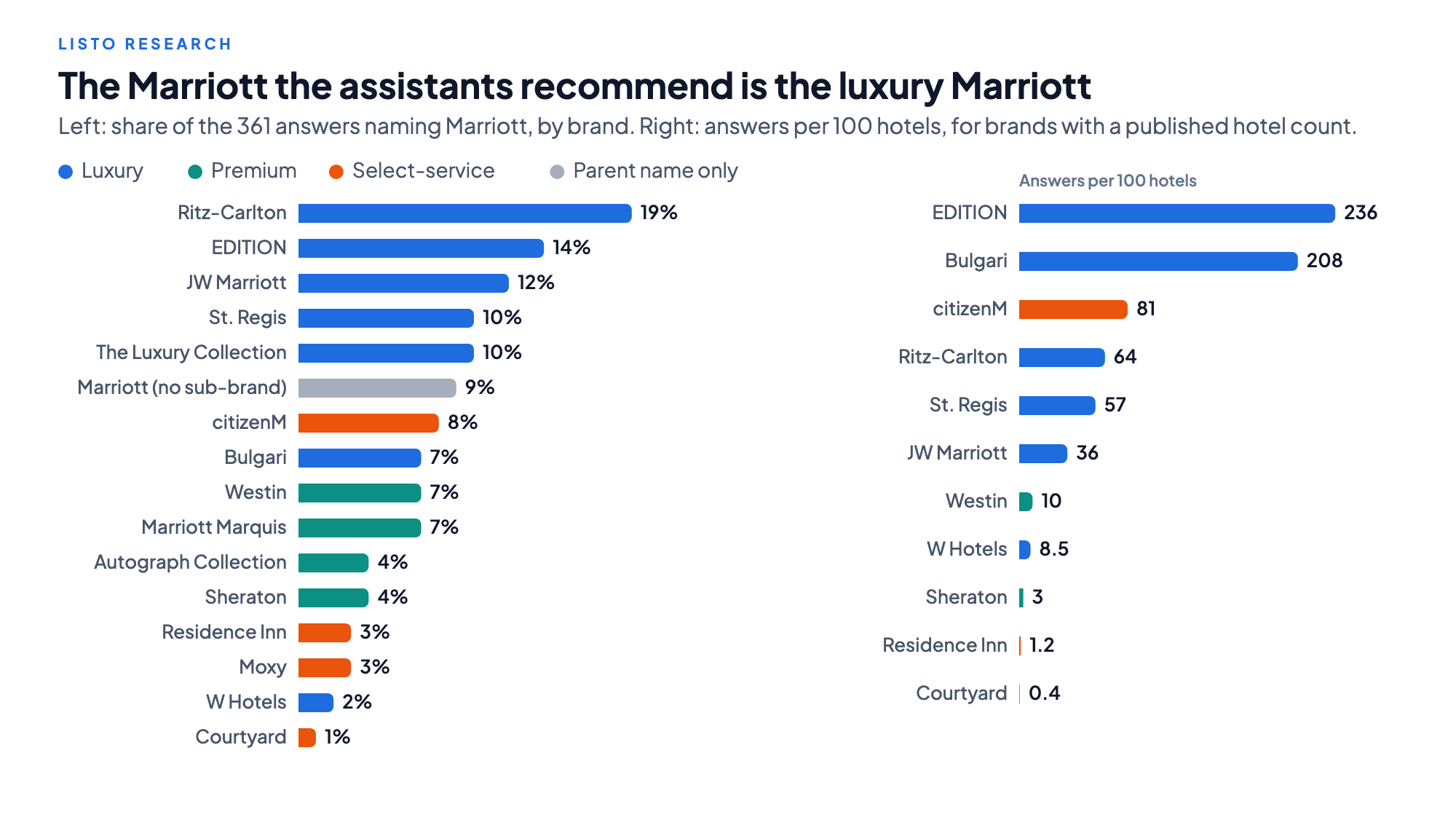
Six luxury brands (Ritz-Carlton, EDITION, JW Marriott, St. Regis, The Luxury Collection, Bulgari) plus W Hotels account for 62% of every answer that names Marriott. Together they are about 500 hotels, roughly 5% of the estate. The premium tier (Sheraton, Westin, Marquis, Autograph, Le Méridien) adds 22%. The select-service brands that are most of what Marriott is (Courtyard, Fairfield, Residence Inn, SpringHill, TownePlace, Four Points, AC, Aloft, Moxy) add 11%.
Put differently: Bulgari and EDITION, 35 hotels between them, are named in more answers (79) than Sheraton, Westin, Courtyard, Fairfield and Residence Inn combined (55), across some 4,000 hotels.
The Marriott the assistants recommend is the luxury Marriott. The Marriott most guests actually stay in, the thousands of Courtyards, Fairfields and Residence Inns, almost never comes up.
Marriott is the clearest case, not the only one. Every large group is carried by a few brands. Accor's presence is Novotel, ibis, Raffles and Sofitel. Hilton's is the Hilton name itself, then Conrad, Hampton and Waldorf Astoria. Hyatt's is Park Hyatt and The Standard. IHG's is InterContinental, then Holiday Inn and Kimpton. Only Accor and Hilton get meaningful visibility from a mid-market brand; for the rest, the luxury end carries the group.
Table 1. The brands that carry each group (share of the group's answers).
| Group | Brands carrying it |
|---|---|
| Accor | Novotel 23%, ibis 20%, Raffles 17%, Sofitel 15%, Pullman 9% |
| Hilton | Hilton 55%, Conrad 23%, Hampton 16%, Waldorf Astoria 16% |
| Hyatt | Hyatt 68%, Park Hyatt 24%, The Standard 23%, Hyatt Regency 19% |
| IHG | InterContinental 45%, Holiday Inn 20%, Kimpton 15%, Crowne Plaza 13% |
Ten cities, four different leaders
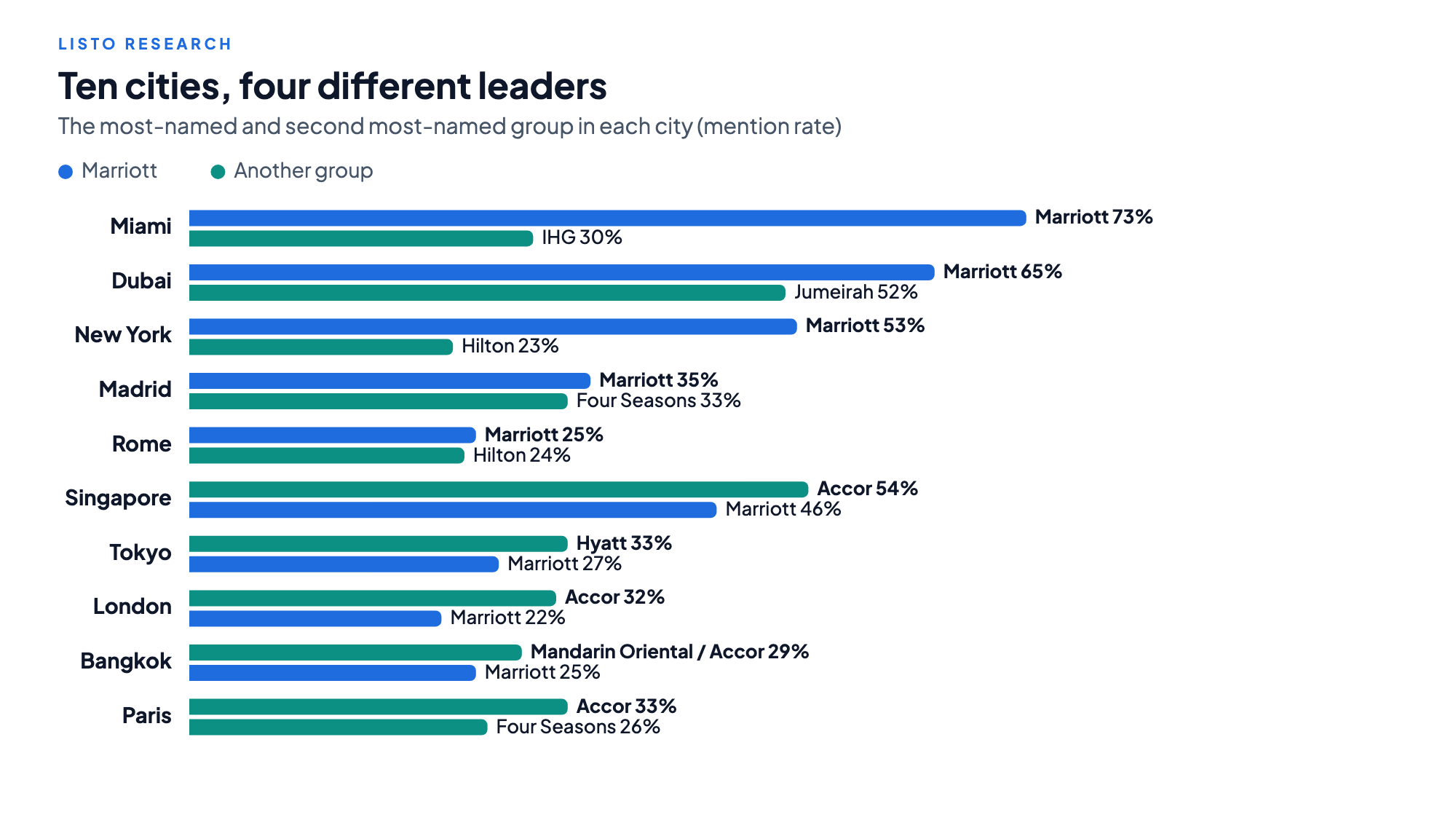
Marriott leads outright in Miami, Dubai and New York, and in each the number rests on one to three luxury properties. In Madrid it is the EDITION and in Rome the St. Regis, both in a dead heat with Four Seasons and Hilton. Elsewhere someone else leads: Accor in London, Paris and Singapore, Hyatt in Tokyo, Mandarin Oriental in Bangkok. Where a group has no marquee property the assistants know, it drops fast. Marriott is at 22% in London and 16% in Paris.
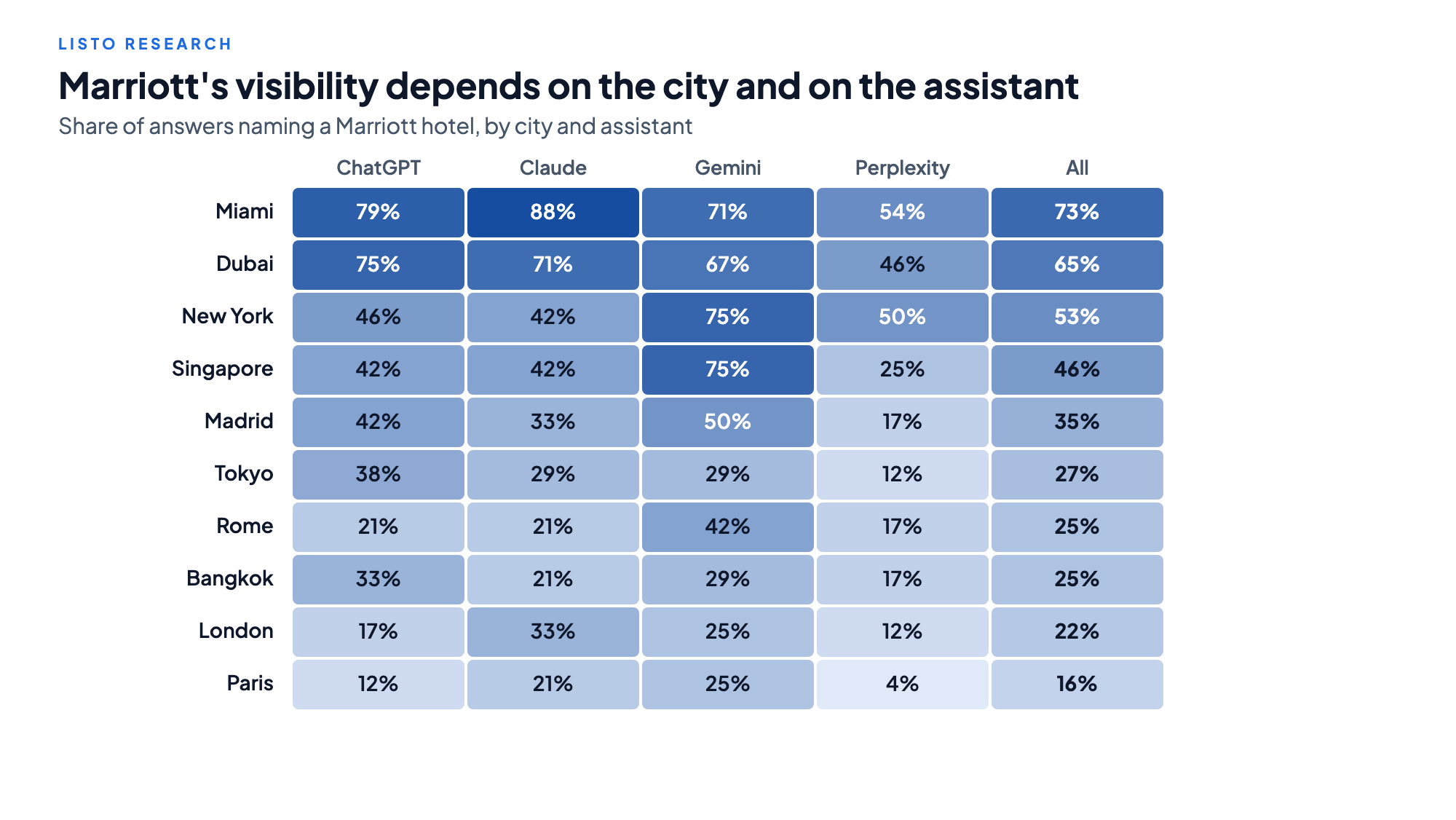
The by-assistant view sharpens it. Gemini names Marriott in 75% of its New York and Singapore answers. Claude does in 88% of its Miami answers. Perplexity names it in 4% of its Paris answers and 12% in London and Tokyo.
Who is asking changes who wins
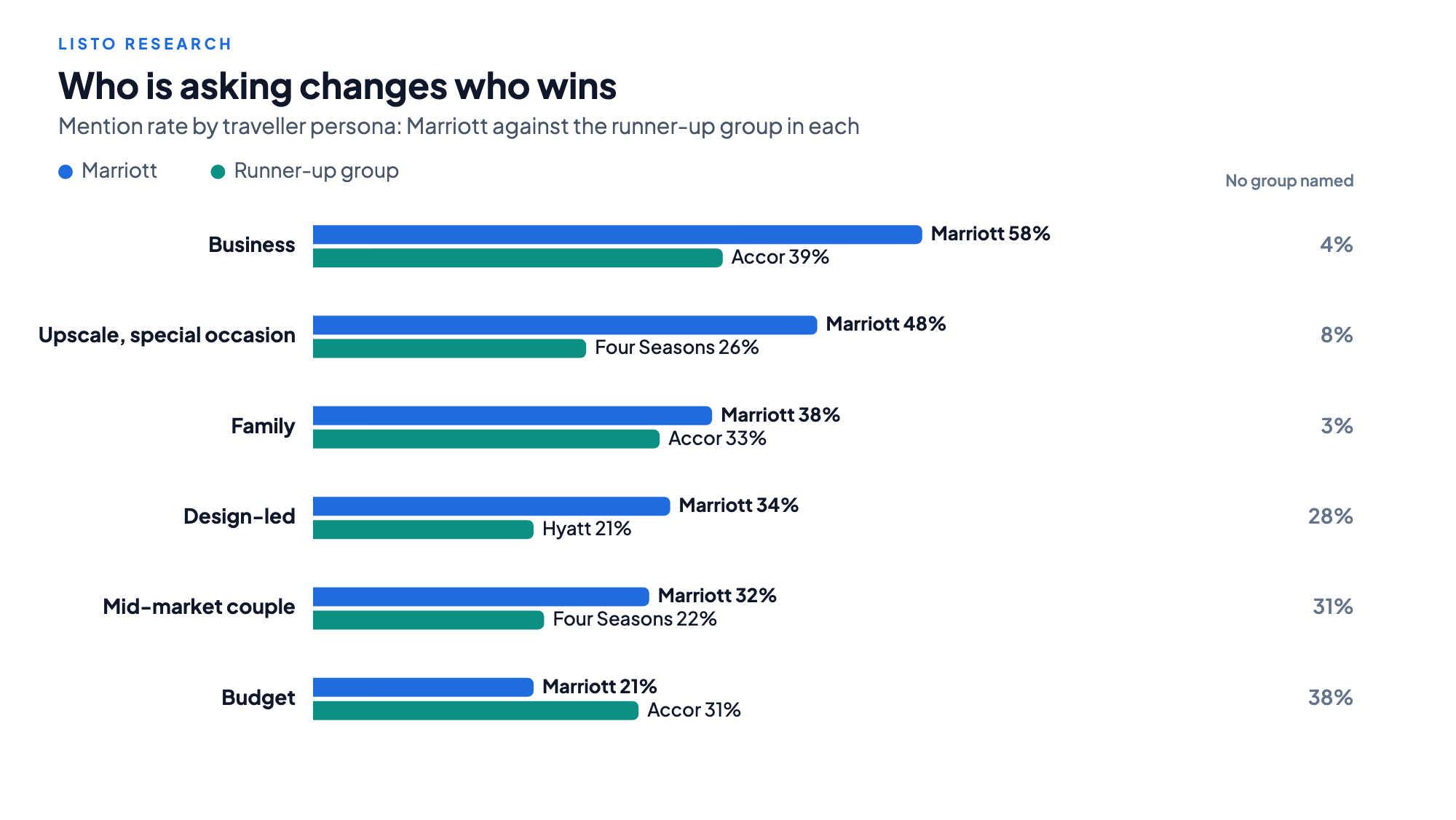
Business travel is Marriott's fortress: it is named in 58% of business answers, and only 4% of those answers name no major group at all. Budget is Accor's, through ibis and Novotel, with Premier Inn behind.
Two things sit underneath the budget number. First, Marriott's 21% would be 11% without citizenM, the 36-hotel design-led budget brand it acquired on 23 July 2025, two months before we measured. citizenM is the only Marriott brand named in 25 answers, 18 of them from the budget persona, and it doubles Marriott's Paris figure from 8% to 16%. Marriott's budget visibility in Europe is largely a brand it bought this summer.
Second, the budget persona is the only one that changes what the assistants recommend. Ask as a family, a couple or a business traveller and a luxury flag appears in 60% to 81% of answers. A mid-market couple asking for "comfortable three to four star" gets a luxury brand 60% of the time and an economy brand 8% of the time. Say "budget" and it inverts: 1% luxury, 60% economy. It holds on all four assistants, with Perplexity the least skewed.
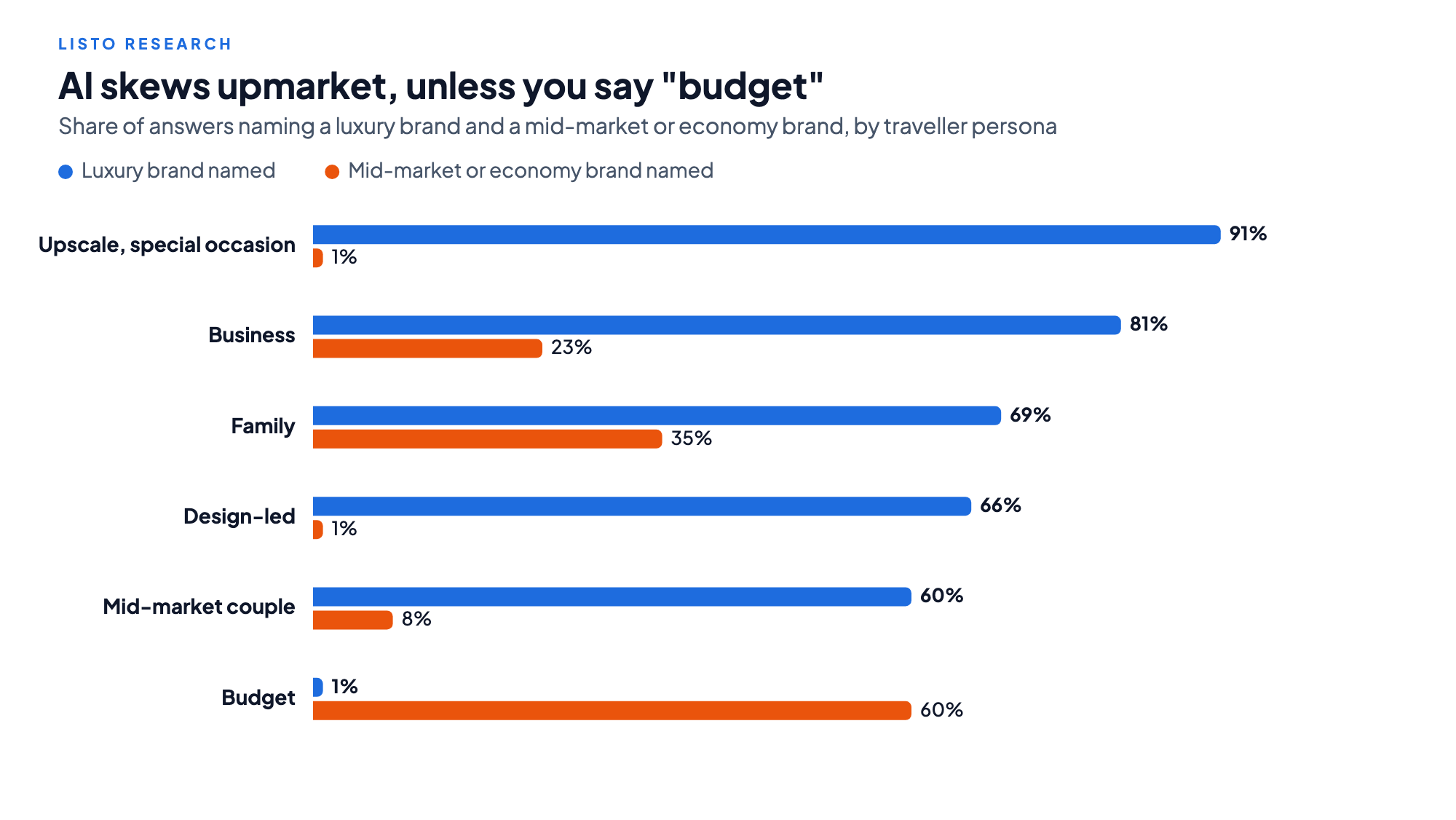
Perplexity is the exception. For the upscale traveller it names Marriott as often as the other assistants do, 48%. For everyone else it barely does: 30% for business, 22% for families, 18% for couples, 12% for budget. On Perplexity, Marriott is a luxury brand and not much more.
AI recommends hotels, not chains
Everything above is measured at group level, because that is how the industry talks about itself. The assistants do not talk that way. They name buildings.
Table 2. The single most-named hotel in each city, and who owns it.
| City | Most-named hotel | Answers | Affiliation |
|---|---|---|---|
| Rome | Hotel Artemide | 27 | Independent |
| Tokyo | Palace Hotel Tokyo | 25 | Independent |
| Miami | 1 Hotel South Beach | 25 | Starwood Hotels (SH) |
| Madrid | Four Seasons Hotel Madrid | 24 | Four Seasons |
| Paris | Hôtel Plaza Athénée | 21 | Dorchester Collection |
| Dubai | Atlantis The Royal | 21 | Kerzner |
| Bangkok | Capella Bangkok | 20 | Capella Hotel Group |
| Singapore | Capella Singapore | 18 | Capella Hotel Group |
| New York | The Kimberly Hotel | 13 | Independent |
| London | Shangri-La The Shard / The Savoy | 12 each | Shangri-La / Accor (Fairmont) |
In eight of ten cities the most-recommended hotel belongs to none of the 20 largest groups. Three are independents in the strict sense: Hotel Artemide, a family-run four-star on Via Nazionale that is also Tripadvisor's number one in Rome; Palace Hotel Tokyo, the only independent Japanese-owned five-star in the city; and The Kimberly in Midtown. The rest belong to small luxury operators with a handful of properties each.
Rome shows the pipeline. Thirteen of Hotel Artemide's 27 mentions come from Perplexity, the assistant that cites Tripadvisor 520 times. Tripadvisor's number one becomes the AI's number one on the assistant that reads Tripadvisor.
One in five hotel answers (19%) names no hotel from the 20 groups at all. Those answers are not empty. They are filled by the long tail of smaller groups and independents in Table 2, and above all in Rome (44% of answers), Tokyo (33%) and Paris (32%).
The last chart makes the point at industry scale.
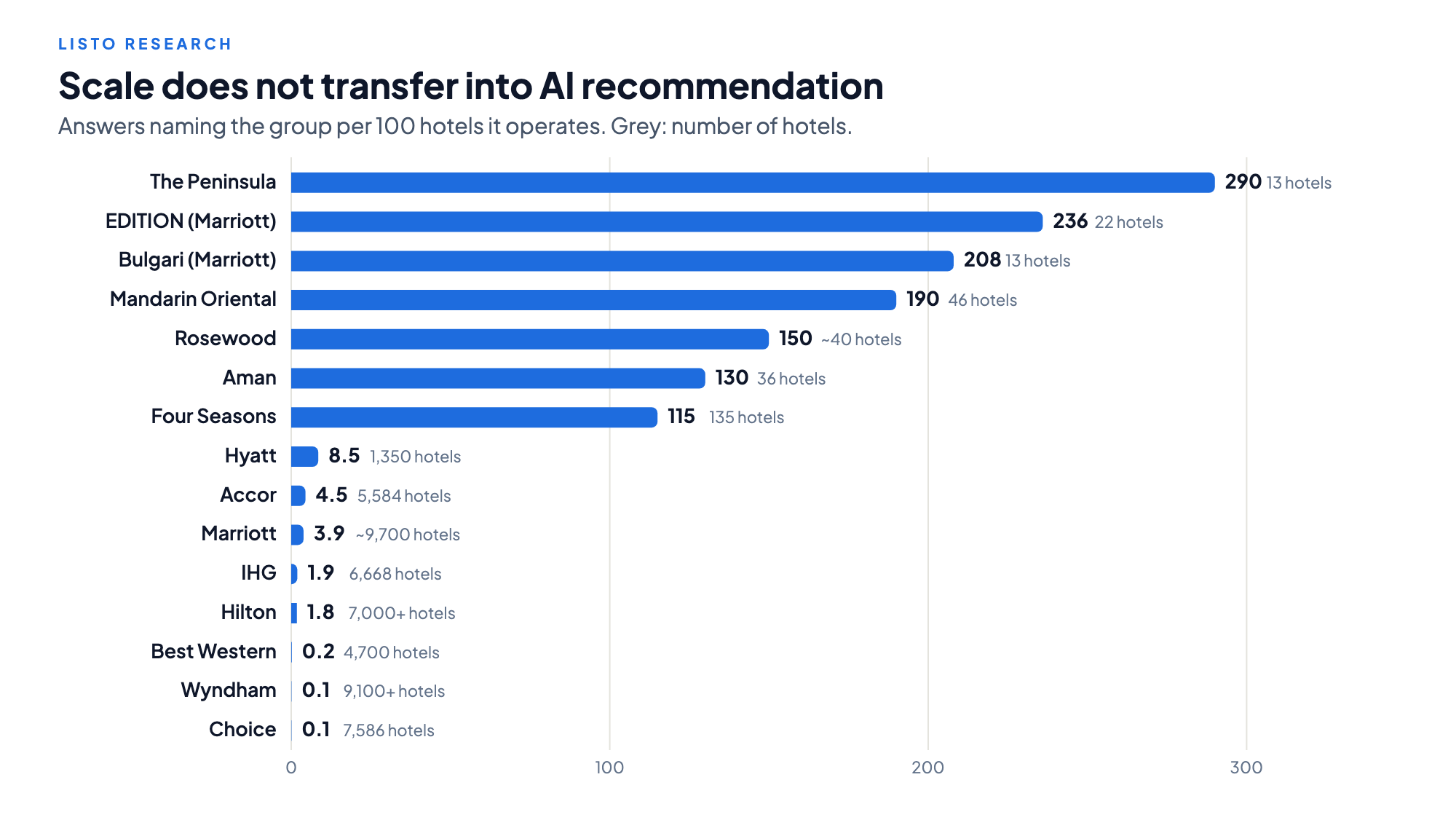
Scale does not transfer into AI recommendation. What transfers is being a hotel that people write about, review and film. The Peninsula's 13 hotels are, per property, roughly 150 times more visible than Hilton's 7,000.
What it means for hoteliers
Measure per assistant, not per "AI". The four assistants agree on which hotel groups to name 13% of the time. A number that does not say which assistant it describes does not describe your visibility.
The assistants read different sources, so your information has to be right in all of them. ChatGPT leans on hotels' own websites and editorial, Perplexity on OTAs and Tripadvisor, Claude on reviews, Gemini on video and forums. What they share is that they are only as good as what they find. A hotel whose facts, descriptions and reviews are complete and consistent wherever they appear is easier for every assistant to recommend.
Your AI visibility is your best property. Marriott's 9,700 hotels are visible through about 500 of them, and in most cities through one. If you run a group, the assistants have already decided which of your hotels represents you. It is worth knowing which.
Scale does not transfer. Wyndham, Choice and Best Western have 21,000 hotels and 1% each. Hotel Artemide has one hotel and the top spot in Rome. The assistants reward hotels that are written about, reviewed and filmed, at whatever size.
Do you know which assistants recommend you, and why?
The same method runs for a single hotel or a portfolio, on all four assistants, with the sources each one relied on. If you want to know where you stand before your next distribution review, start with the free diagnostic.
Free diagnostic →Methodology
Ten one-city studies were run on the Listo GEO platform in September 2026, from a United States searcher, one sample per prompt. Six personas (budget-conscious, mid-market leisure couple, family, business, upscale special-occasion, design-led) asked for hotel recommendations, each question phrased two ways, of ChatGPT, Claude, Gemini and Perplexity: 960 answers in total.
Every answer was matched against the full brand lists of 20 hotel groups, whole-word and case-aware, then audited. Aliases that are also place names or common words were corrected with evidence (Jumeirah the district, Hyde Park, Regent Street, "a lush courtyard", the NoMad neighbourhood, "la dolce vita"). Properties the assistants name without the chain word were credited to their group where ownership was verified (The Savoy and The Plaza to Accor, Crillon and Villa Magna to Rosewood, George V to Four Seasons, Rome Cavalieri to Hilton, Bulgari, citizenM, Santo Mauro and Al Maha to Marriott, ME hotels to Meliá). citizenM is treated as a Marriott brand throughout; Marriott completed the acquisition on 23 July 2025. Partnership brands that a group does not own (Small Luxury Hotels, Iberostar, Banyan Tree, Faena) were not credited to any group.
Competitor matching was done on answer text capped at 2,000 characters, so competitor figures are floors and near-ties are reported as ties. Marriott's figure combines the platform's full-text flag with the text match. "Outside the 20 largest groups" is what the residual measures; a hotel is called independent only where its ownership was checked. Hotel counts are from company disclosures and press: Marriott ~9,700, Hilton 7,000+, IHG 6,668, Wyndham 9,100+, Choice 7,586, Accor 5,584, Best Western 4,700, Hyatt 1,350, Four Seasons 135, Ritz-Carlton 108, JW Marriott 121, W Hotels 71, St. Regis 61, Mandarin Oriental 46, Aman 36, citizenM 36, EDITION 22, Bulgari 13, The Peninsula 13, Sheraton 431, Westin 250, Courtyard 1,300, Fairfield 1,169, Residence Inn ~900. Rosewood and The Luxury Collection are approximate.
Capuano's remarks are from the Bank of America investor conference, 9 September 2026, as reported by Skift.