When the agent holds the card: OpenAI, Visa and agentic payments
Over the past year, the agentic stack has been quietly filling in. Agents can be found, discovered, connected to live systems, and walked all the way to a checkout. But one piece was missing, and it was the most sensitive of all. An agent could fill a cart. It could not pay. On June 11th, OpenAI and Visa changed that.
The last missing piece was the money
For most of this shift, the hard problems have been about information and action. How does an agent find a service, read it, choose it, assemble an order? Each of those got a standard. But the final inch of any purchase is different. It is not data. It is money, and money runs on trust that took the card networks the better part of a century to build.
You can let an agent read your systems through an MCP. You can let it discover capabilities through a registry. You can let it assemble a checkout. None of that required anyone to hand an autonomous program their card number. Payment did. That is the wall the networks just stepped over.
What OpenAI and Visa announced
On 11 June 2026, at Visa’s Payments Forum in San Francisco, Visa and OpenAI announced that tokenised Visa credentials can now power agent-initiated checkout inside ChatGPT and Codex. In plain terms: an AI agent can complete a real purchase, with real money, on your behalf.
Visa is not improvising here. It launched Visa Intelligent Commerce in April 2025, with OpenAI among the founding partners. What changed in June is that the capability turned consumer-facing. The agent in your chat can now reach for a card.
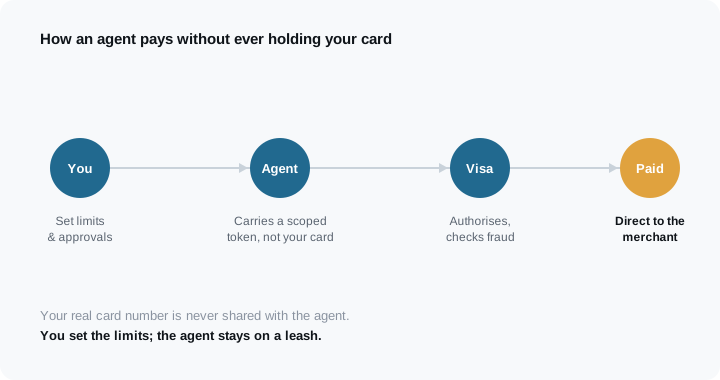
Crucially, the announcement is framed around control, not autonomy. Transactions run inside parameters you set: spending limits, merchant-category restrictions, approvals for anything above a threshold. Real-time fraud monitoring sits over all of it. The stated principle is that the consumer stays in command even when the agent executes the transaction.
How an agent pays without holding your card
The mechanics matter, because they are what make this safe enough to ship. Three ideas do most of the work.
- Tokenisation. The agent never receives your real card number. Visa issues a network token scoped to that specific agent. If it leaks, the damage is bounded, and it cannot be replayed against a different merchant.
- Delegated, bounded requests. Payments are sent as one-time requests with a cap and an expiry, not standing access to your account. The agent is handed exactly enough to complete one purchase, and no more.
- Verifiable agent identity. Through emerging trust layers such as the Trusted Agent Protocol, a request carries a cryptographic signature bound to the merchant’s domain, so the merchant can confirm the agent is who it claims to be and that the request was not replayed.
And one detail that should sound familiar from earlier in this series: the checkout state stays on the merchant’s systems. OpenAI is not the merchant of record. The agent moves the money; it does not own the relationship.
This is a stack, not a single product
It is tempting to read the headline as “ChatGPT can buy things now.” The more useful reading is that the last layer of a stack just shipped. Discovery lets an agent find you. A connection lets it read your live systems. A checkout protocol lets it assemble the order. And now a payment layer lets it settle the bill.
Several standards are converging on that last layer at once. OpenAI’s Agentic Commerce Protocol, built with Stripe, defines the product feed and the delegated payment flow. Google’s Agent Payments Protocol does the equivalent in its world. Visa’s tokens and trust rails sit underneath them. We went deeper on the checkout side in what UCP means for hotels, and on the discovery side in the Agentic Web.
Two networks, one day
The clearest signal was not the partnership itself, but the timing around it. The same day, Mastercard launched its own agentic-payment framework at a separate event. Two of the largest payment networks on earth moved on agentic commerce within hours of each other, with no coordination between them.
When fierce competitors converge that fast, it is rarely speculation. It is usually because they have all seen the same number. In this case the number is a projection of roughly a trillion dollars in US agentic retail by the end of the decade. Treat the figure as a forecast rather than a fact, but the direction is not in doubt.
A new actor enters the purchase
Step back, and something larger is happening. For the entire history of commerce, a transaction has had two sides: a buyer and a seller. Agentic payments insert a third party that acts with real authority on the buyer’s behalf.
That actor needs the things any trusted participant needs: an identity, a reputation, a place it can be verified. The same week, the ecosystem began building exactly that, with agent scores, agent directories, and fraud models tuned for machine-initiated transactions. It is the same pattern we saw with discovery: before an agent can be trusted to act, it has to be something the other side can verify.
What this means for companies
If you sell anything, a new question is about to join the list: can an agent actually pay you? Being found, being discovered, and being chosen all collapse to nothing at the final inch if the purchase cannot complete. The readiness checklist rhymes with everything else in this shift:
- A machine-queryable product feed, so an agent can see what you sell and for how much.
- A checkout an agent can call, an API, not a form built for human fingers.
- A way to verify the agent and accept a delegated, tokenised payment within the limits it carries.
- An audit trail per agent, so you can see who bought what, on whose behalf.
For hotels, this is the distribution story again, one inch further down. If a guest’s assistant can pay Booking but cannot pay you, the assistant books Booking. The direct relationship is lost, not because you were invisible, and not because you could not be reached, but because you could not take the payment at the moment the agent was ready to give it.
At Listo, we have been building for this whole arc: visible in AI answers, discoverable to agents, connected through MCP, and ready to transact when the conversation reaches checkout. Agentic payments are the piece that turns all of it from a demo into revenue. The agents can now hold a card. The only question left is whether, when one of them is ready to spend, your business is ready to be paid.
Sources: Visa and OpenAI, “Building the future of AI commerce,” Visa, 11 June 2026; coverage from PaySpace Magazine and others; Mastercard’s agentic-payment announcement, same day.
When an agent is ready to spend, can you be paid?
Our free diagnostic shows how visible and connected your business is to AI assistants today, with the priority fixes to get there.
Free diagnostic →